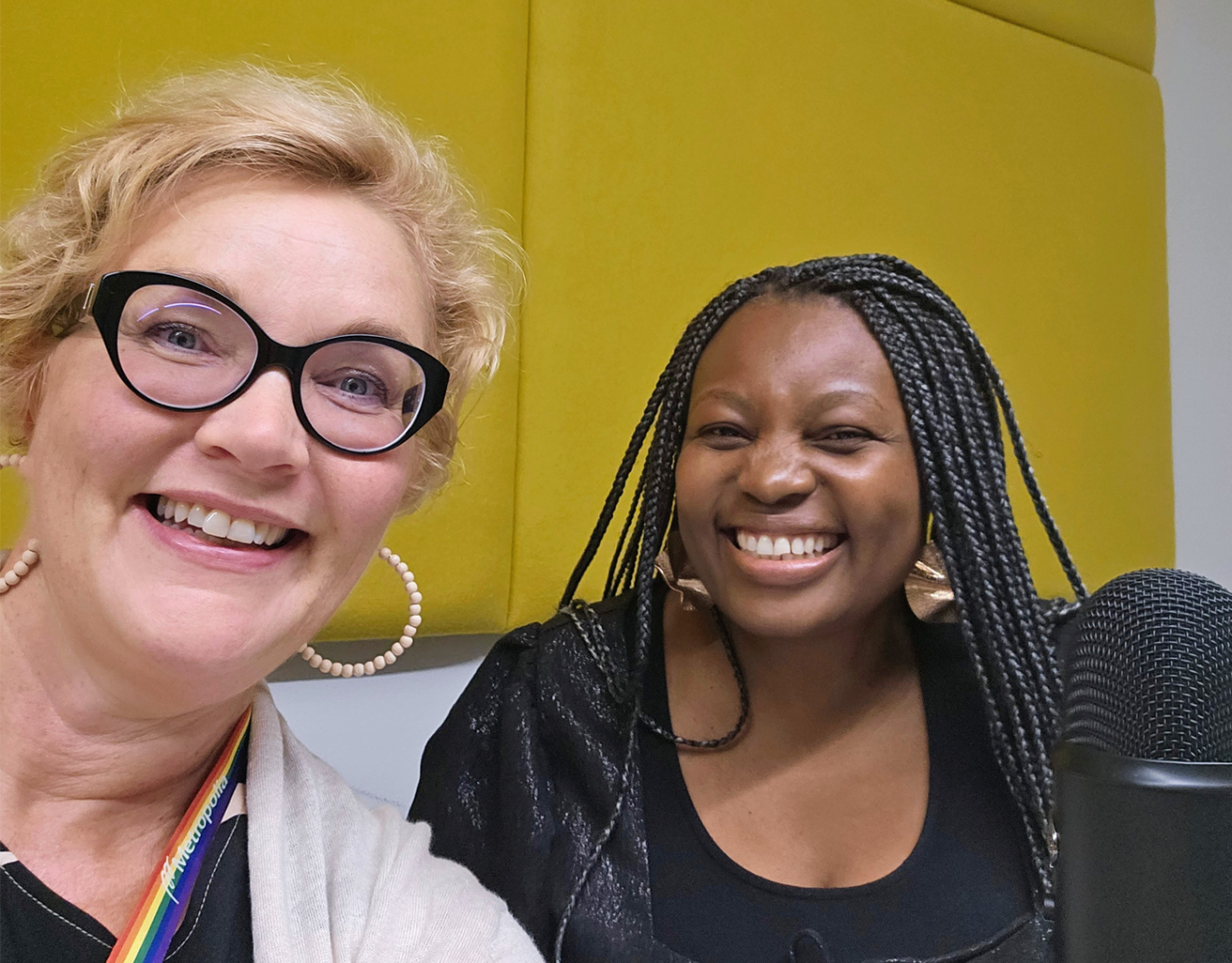
Toini Palo: Welcome to the Co-Creating Learning Beyond Borders podcast. In this podcast series, we will focus on innovative, collaborative, and boundary-spanning approaches to education, especially those that encourage people from different backgrounds to create learning experiences together. In this episode, Getting Mindset for the Age-Tech Design, we are diving into the world of user-friendly age-tech design. What does it mean and require, and how to help students and entrepreneurs to learn about it? My name is Toini Palo, and today with me are two wonderful professors from Singapore Institute of Technology, Agnes Xue and Peck Horn Ong. You are warmly welcome.
Agnes Xue: Thank you, Toini, for your introduction. Hi, everybody. I’m Agnes. I’m an industrial designer by training, but I’ve been in the healthcare space for about 20 years. So, my interest in this podcast topic really sits at the intersection of age-inclusive design, health innovation, as well as transdisciplinary education. And it connects very naturally with both my research, my role in SIT, as well as enhancing health. And I think it’s related to Metropolia’ s longstanding work in gerontology and user experience design for age tech. So, I feel that now is a better time than any to really start comparing how Singapore and Finland are each building ecosystems where our seniors, our clinicians, our designers, our engineers, our businesses can co-create technologies that genuinely support aging in place. rather than just adding more smart devices or smart products here and there. So, I think professionally, there’s also a deep interest in how initiatives like SIT’s Health Living Lab, and as well as in Singapore’s SingHealth community aging ecosystems, how they can connect with Metropolia’ s age-tech co-development platforms and projects in your innovation hub as well. And I think, again, as I mentioned, the different disciplines like design, like engineering, like allied health, the social sciences, as well as our research in data and AI can share methods, practices, even ethical frameworks about what happens when we are co-creating age-tech with seniors and care providers. And of course, another strong interest for me is the education dimension. How can we, from all that we are doing, build continuous practice-oriented learning pathways for our students, for our professionals, so that they can continue to design and or even procure and implement age-tech responsibly in their area of work overtime. I think with our countries push for population health, as well as digital health literacy. I’m sure there’s also a lot of developments in Finland site in continuous education for age-tech. I think that this is really an interesting space to talk about how things can emerge, frameworks, standards or guidelines, how they can then be translated into everyday products across countries.
Toini: Thank you very much. Based on your very long experience in this area, I think that you have also perspective about students’ attitudes in terms of age-tech and designing. How do you see this perspective? Have you seen any kind of changes during this long term?
Agnes: I think when we’re talking about students, there’s probably two groups. One will be our undergraduates who have lesser work experience, and they are probably still figuring out from theory how to apply in practice. But these days, I think in both countries, we have a very growing number of students who are adult learners, who are professionals, working professionals, coming back to school, either doing their graduate studies or taking short courses to upscale and upgrade. This group, the second group of students, are quite an interesting bunch because they bring along with them their work experience, which is very rich, and they may have seen so many more developments than us academics who are in the institutions. Yeah, so I think there will be different approaches, how we curate content for these two different groups of students. I think there’s so much to learn from, especially the adult learners’ group, but sometimes they may come in with a bit of a fixed mindset. They want to touch and go, maybe get a certain certification, thinking that that will probably help in their pay package and then walk away with it. So, when it comes to things like co-creation, co-development for age tech, these may be concepts that they will often feel that I don’t have the time or the luxury of time to spend so many hours with my stakeholders or the seniors to co-develop things. So, these concepts, I think sometimes we may first have to unlock that mindset of our learners for them to be able to reframe challenges or reframe how they think about solutioning.
Toini: Yes, that’s true. And it’s, I think, very interesting that both Singapore and Finland, our citizen is more aging. So, this is somehow challenging us and it is challenging our students as well. But how I see it, how it is in Finland, I would say that, this age-tech is coming step by step into students’ world as well. It hasn’t been so much in there, but it is coming more and more. And this kind of collaboration with you and Singapore Institute of Technology is a very nice way to somehow waken up students as well so that they can find new possibilities through this kind of collaboration. Okay, thank you very much. And then Peck. You are working as a deputy cluster director and program leader for the Bachelor of Science and Honours in Physiotherapy. And you are in daily contact with the students, including those abroad. What is your experience of students’ knowledge, attitudes and competencies related to user-friendliness and age-tech design. How do you see it?
Peck Horn Ong: That’s a great question. Let me first say how wonderful it has been to have had the ability to meet your students and work with them through this project. I think it has indeed been a privilege. Coming back to your question, we know that culture and the environment the students grew up in, will shape how they view and think about aging and age-tech. As Agnes shared, like Metropolia, our students at SIT also come from diverse backgrounds. We have adult learners and then the younger ones, but majority of them have grown up immersed in digital tech. I think they can’t imagine what it is like to live without technology, and some may have very limited interaction with older adults as well. So, what does this means is that the challenges older adults face when using technology are not always intuitive to them at first, right? Because they can’t understand. But that said, I think students generally come in with very strong technical discipline knowledge. But understanding of user friendliness, especially in the context of aging, I think is often quite superficial or sometimes quite biased, it’s usually one extreme or the other. Therefore, there’s often an assumption that if something is very technologically advanced, it looks good, they use it and it’s really fun, it’s going to be helpful for the older adults as well. So, what we see, particularly through a project like the one that we have done, is a real shift in the mindset. As our students are given the opportunity to engage directly with caregivers and real-world contexts, they really begin to develop this understanding that user-friendliness is cultural and profile specific. It’s not about how fancy technology is, it’s not about simplifying the technology, but it’s about respecting the lived experiences, the needs, and the preferences of the people using it. Basically, keep in mind who you are designing for, right? For many students, this project has been eye-opening. It helps to move from a technology-first mindset to a human-first, context-aware approach to each tech design, which I think is a really, really privileged and powerful learning experience for them.
Toini: I remember also students from Finland who have their idea about what is the life of aging people in Finland and what are their preferences. But when they came to Singapore, they realized that, wow, this is different kind of world and different kind of preferences with these people here. For example, concerning nature and the meaning of nature for their everyday lives. In Singapore, you like to be together with other people, and you like to go to shopping centers more than forests, for example.
Peck: One of the things that I just want to add is that some of the students are actually doing a survey now. They’re also noticing it’s not like a uniform like culture in Finland versus Singapore. There are different profiles of older adults as well. Their needs and their preferences is also very different. We need , really, when we’re actually designing age-tech, we really need to be, keep in mind, who our target audience is we’re trying to. Because those who are more educated, less educated, or more affluent, less affluent, all those factors actually really influences what their needs are as well. So, we really need to keep that in mind.
Toini: That’s right. This project has been eye-opening. Also, for that, what kind of challenges can it be when aging people are living alone at home or they are living with family. It’s so different. And we need to take into consideration when we are designing age-tech for aging people. And if we think that these technologies could be globally used, there are really many kinds of challenges that we need to handle first. The Co-creating Learning Beyond Borders podcast is produced by the Design Thinking and Co-creative Learning through Transdisciplinary Simulation-based Education Project as part of activity of Team Finland Knowledge Program 2023 in collaboration with Metropolia University of Applied Sciences and Singapore Institute of Technology.
Featured in the podcast
-

Toini Palo
Principal Lecturer, Metropolia UASDr.Sc (Soc. Sciences) and Lic. in Philosophy Toini Palo is a researcher in Metropolia in Future Proof Health and Wellbeing innovation hub. She designs and conducts transdisciplinary RDI in the field of aging and health. Her interest is focused on health promotion, enabling meaningful life and co-design user-friendly solutions.
About the author -
Agnes Xue
Associate Professor, Singapore Institute of Technology (SIT)Agnes Xue, PhD, Associate Professor at SIT, is an award-winning industrial designer and healthcare innovation leader specializing in user-centric medical technologies. With expertise spanning design thinking, healthcare delivery, and translational research, she brings unique interdisciplinary insights to digital health, community care solutions, and patient-centered innovation, strengthening research-industry collaborations.
About the author -
Peck Hoon Ong
Associate Professor and Deputy Cluster Director, Singapore Institute of Technology (SIT)Peck Hoon Ong is an Associate Professor and Deputy Cluster Director in the Health and Social Sciences cluster at the Singapore Institute of Technology. She previously led the Physiotherapy programme for five years. Her work focuses on improving rehabilitation and health services to better support older adults and people living with disabilities. She is passionate about advancing healthcare education and developing practical solutions that improve care in real-world settings.
About the author