Learning
-

Ria Gynther
Responding to AI-driven industry change in game education
The pace of change in the game industry is placing increasing pressure on game education to keep up with professional practice. At the Game Educators’ Meeting 2026 in Helsinki, educators and industry representatives discussed how artificial intelligence is reshaping the industry’s production models and competence requirements. Focus was on validation, practical learning and new approaches to recognising skills.
-
Pamela Spokes
U!REKA Change Agents engage students in challenge-based learning to develop skills for innovation
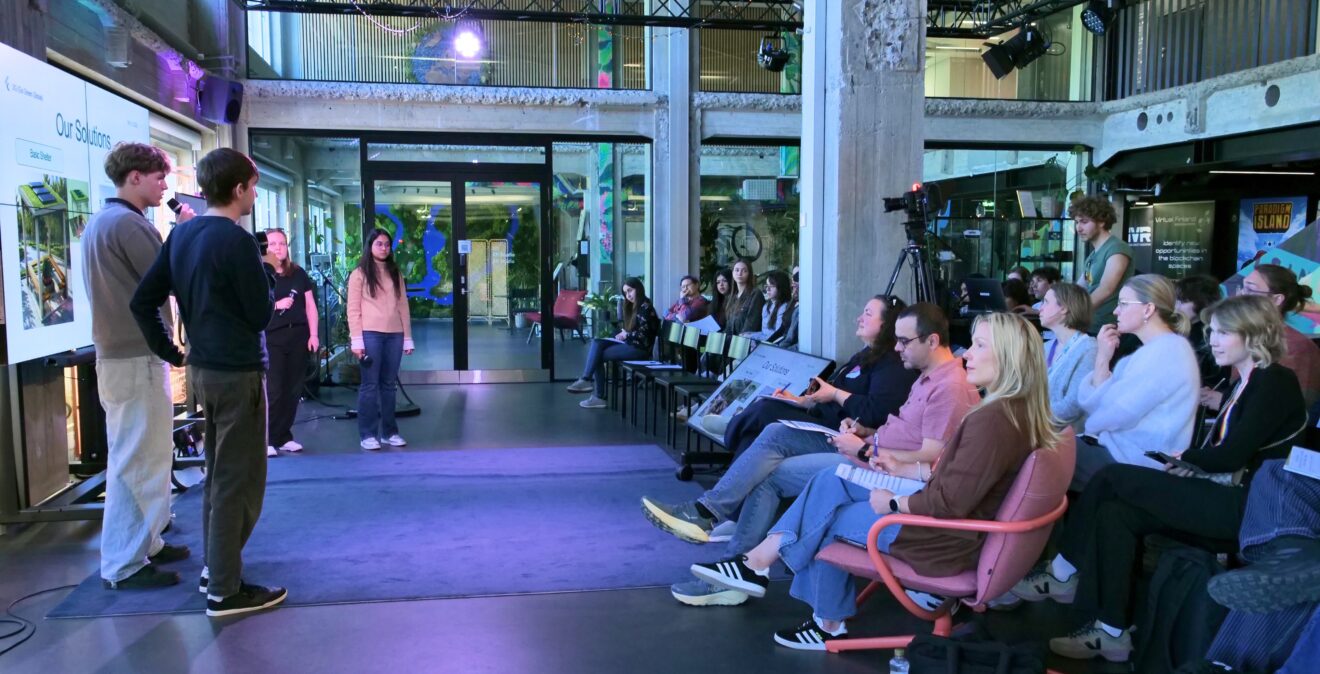
The future requires different skills than what previous generations have focused on. Challenge-based learning (CBL) has come out of these needs to equip students better for the future. U!REKA Change Agents programme is the European model for CBL. The 2025 edition of U!REKA Change Agents course was held in Helsinki.
-

Eunice Siame-Moono
Generative AI as a learning companion in bilingual nursing education
In functionally bilingual nursing education, learning is shaped not only by clinical content but by language, confidence, and access to practice. Drawing on my experience across student, support, and innovation roles, this article explores how AI can support more inclusive and practice-ready learning.
-

Pamela Spokes
The design is the event – why what happens before an innovation challenge matters most
In the context of innovation challenges, the theory of challenge-based learning is well-established. What is less well-documented is the practical design intelligence required to build a successful event. This article tells you how to do it.
-

Toini Palo, Frank Guan
Episode 3: Learning in hybrid or remote simulation
In this episode of the Co-creating learning beyond borders podcast Toini Palo and Frank Guan explore innovative uses of virtual and augmented reality in education, focusing on simulation-based learning across international and cultural boundaries.
-

Toini Palo, Agnes Xue, Peck Hoon Ong
Episode 2: Students, industry, and user-friendly age-tech
In this episode of the Co-creating learning beyond borders podcast Toini Palo, Agnes Xue and Peck Horn Ong explore the importance of user-friendly age-tech in supporting dignified and autonomous aging, and the wide-range of opportunities the field presents for students from diverse disciplines.
-

Pamela Spokes
Campus to company: Why Finland should encourage student entrepreneurship
Finland has navigated economic transformation before: after gaining independence, after the Second World War, and during the recession of the 1990s. Today another transition may be underway as artificial intelligence begins to re-shape many entry-level jobs and jobs that include a lot of repetition.
-
Toini Palo, Agnes Xue, Peck Hoon Ong
Episode 1: Getting mindset for the age-tech design
In the first episode of the Co-creating learning beyond borders podcast Toini Palo, Agnes Xue and Peck Horn Ong dive into the world of user-friendly age-tech design. What does it mean and require? How can we help students and entrepreneurs learn about it?
-

Ria Gynther
Making game industry competence visible
Game industry roles and skills often have multiple meanings depending on the context, which can make it difficult to see what career opportunities are available or to demonstrate what you can do. Gamebadges aims to change this by making industry-specific competences clear, understandable and demonstrable through a transparent verification system.
-

Ria Gynther
Digital badges explained
In a rapidly digitalising education and job market, traditional qualifications do not always reflect individuals’ actual abilities. Digital badges can provide a practical way to recognise and communicate skills, learning, and professional development.