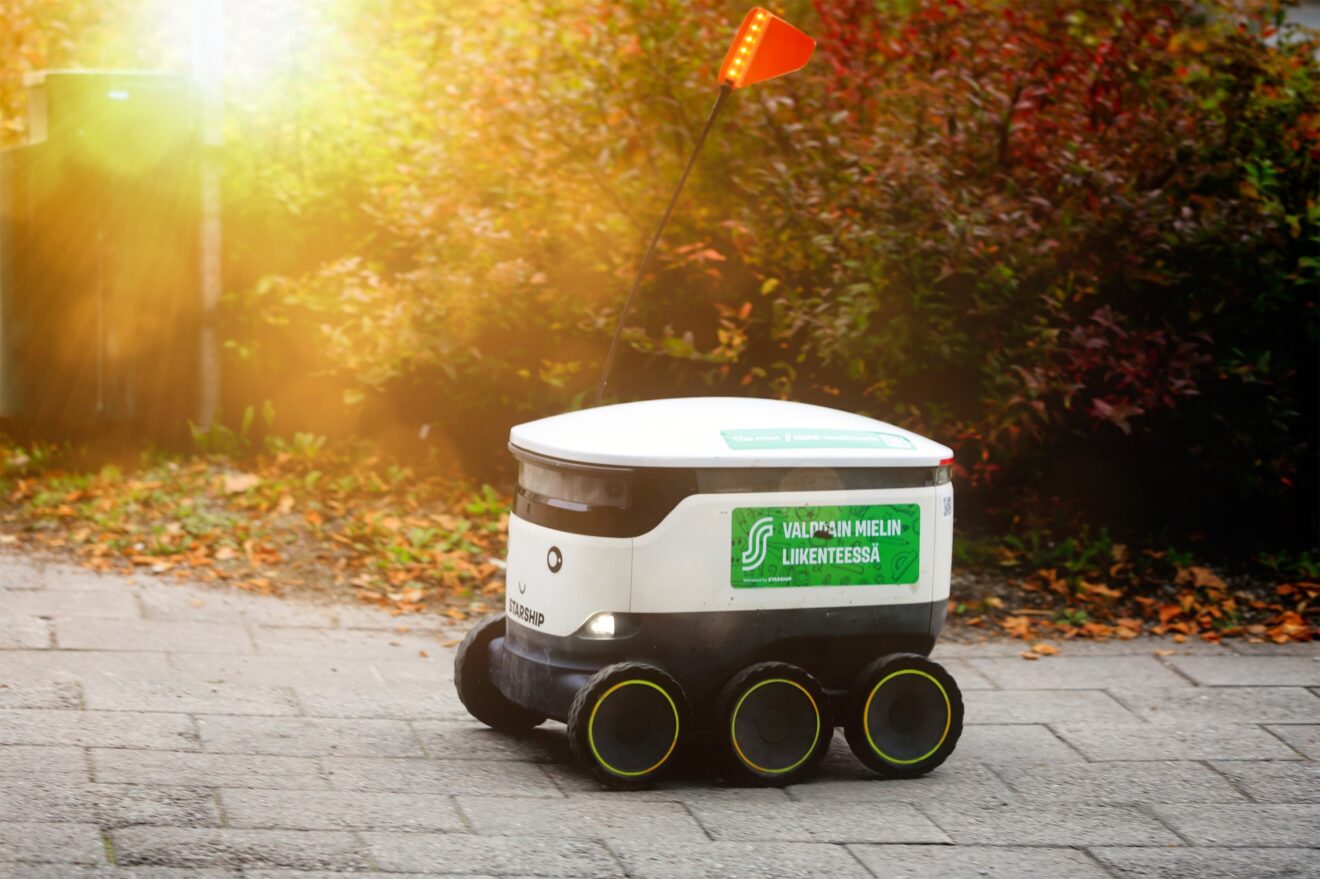
On a Helsinki pavement, a small white robot waits for a pedestrian, indicators blinking, and continues with someone’s groceries inside. To passers-by, it is barely worth a glance. To the lawyers, insurers, transport planners, and city authorities trying to keep pace with autonomous mobility, it is a quiet sign that the future is already on the pavement, and that the rules for it are being written, often quietly and case by case.
The friendliest face of a complicated technology
The robot belongs to a fleet operated by Starship Technologies with Finnish grocery retailer S Group. By the end of 2025, robot deliveries from S-kaupat had passed one million orders, accounting for up to a fifth of online grocery sales in some neighbourhoods (Starship Technologies 2025). Starship describes Finland as one of its most useful learning environments, partly because northern winters force the technology to handle conditions warmer test markets cannot offer.
This is the friendliest face of autonomous mobility: slow, small, locally bounded, easy to step around. Research on attitudes toward last-mile delivery robots and drones suggests that acceptance depends on perceived usefulness, perceived safety, and how comfortable people are sharing space with the machines (Yuen et al. 2022; Cicek Simsek et al. 2025), with a Finnish study finding broadly positive responses where services were framed as supporting sustainable mobility (Oksman & Kulju 2024).
The friendliness can be misleading. Delivery robots are reassuring because they are slow, locally bounded, and low-stakes when they fail: at worst, a delayed grocery order. The other vehicles called autonomous are not. Buses carry passengers; robotaxis share mixed traffic at urban speeds; logistics drones move at altitude over public space; private cars running driver-assistance software do so at motorway speeds. The technical question of how each one drives itself looks similar. The social and regulatory questions of what happens when something goes wrong do not.
What autonomy could deliver
Autonomous mobility is being pursued for several reasons. The first is safety: most road traffic injuries and deaths are caused by human factors including inattention, fatigue, and impairment. A vehicle that does not get tired or distracted is, in principle, capable of safer driving in many conditions. The second is access: autonomous mobility could expand transport options for older adults, people with disabilities, children, and those living in areas with limited public transport. The third is operational: autonomy is increasingly considered as a possible response to driver shortages in public transport and logistics, and as a way to operate routes that would otherwise be financially unsustainable.
The fourth, and possibly the most far-reaching, is the reshaping of car ownership. If autonomous vehicles can move between users without a driver, fewer vehicles are needed to deliver the same level of mobility. Modelling work commissioned by the OECD’s International Transport Forum has suggested that, in dense urban contexts, individual car ownership could fall by as much as 90 per cent if shared autonomous fleets were widely adopted (International Transport Forum 2015). Milakis, van Arem and van Wee (2017) trace this as part of a wider set of ripple effects on land use, parking demand, energy consumption, and the structure of the wider economy.
The same literature warns of induced demand: cheaper travel can prompt more trips, empty vehicle travel between users may increase total distance driven, and any drop in ownership can be offset by more kilometres in the system. The net effect depends on whether shared services displace private ownership rather than add to it.
Autonomy is not a single technology
The most widely used framework for describing how autonomous a vehicle actually is comes from Society of Automotive Engineers (SAE) International. The SAE J3016 taxonomy distinguishes six levels of driving automation, from no automation at Level 0 to full automation at Level 5, with driver assistance and partial and conditional automation in between (L0 to L5; see Figure 1) (SAE International 2021). The distinction is rarely visible in everyday language, but it shapes how vehicles are tested, who is liable when something goes wrong, what infrastructure is required, and what the public is being asked to accept.
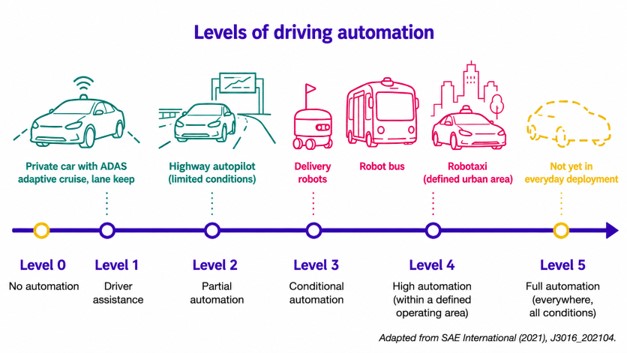
The gap between the levels is wide. A car that brakes automatically for a pedestrian sits at one end; a robotaxi operating without a driver in a defined urban area sits at the other. Treating them as a single technology raises the stakes of language: if autonomous is taken to mean independent in all situations, the ordinary limits of current systems (defined routes, restricted operating areas, remote supervision, on-board safety operators, and carefully chosen weather windows) look like failures rather than reasonable design choices.
The level that has caused the most practical concern within the industry is Level 3, conditional automation. The vehicle drives itself in some conditions, but a human must take over when the system asks. The handoff problem is well known: if the system performs well most of the time, the human’s attention drifts, and a sudden takeover request may not give them enough time to regain situational awareness. Several manufacturers have hesitated to deploy Level 3 in real traffic for this reason. Level 4 is different by definition: within its defined operating area, the system handles everything without a human fallback.
Milakis, van Arem and van Wee (2017) trace what they call the ripple effects of automation, from changes in traffic and travel choices to longer-term shifts in vehicle ownership, land use, energy demand, public health, social equity, and the wider economy. The question is not only whether a vehicle can drive itself, but what kind of mobility system is being built around it. Finland is already climbing the spectrum.
A transition assembled in pieces
The delivery robot on the pavement is the visible edge. Public transport is the next layer up. In November 2025, Tampere, Finland, began regular paid operation of robot bus line 301 between Lintuhytti and Hervantajärvi, a short feeder route connecting a residential area to the city’s tram network (Nysse 2025; metaCCAZE 2025). The vehicle currently operates with on-board safety supervision, with the operating model designed to move toward remote oversight as the service matures. A robot bus does not have to replace a route map to be useful. A robot bus can be worthwhile even if it does not take over normal fixed-route bus service.
Tampere’s line is the most recent visible service, but it sits on top of nearly a decade of cumulative work. Metropolia University of Applied Sciences has been involved in projects including Sohjoa Baltic (Sohjoa Baltic 2020), FABULOS (FABULOS 2021), Sohjoa Last Mile, and mySMARTLife (mySMARTLife 2022), with automated minibus pilots in Helsinki districts such as Kivikko and Kalasatama. These pilots produced technical learning about how vehicles behave in real traffic, organisational learning about how they are procured and operated, and practical experience of how passengers respond when meeting a driverless bus for the first time.
Autonomous mobility also extends beyond roads. In Oulu, the UAM Oulu initiative is developing the city as a testbed for unmanned aircraft systems and urban air mobility (UAM Oulu 2024), while the University of Oulu’s AeroPolis project examines autonomous urban micro-airports and logistics-ready drones (University of Oulu 2024). Many drones are still remotely piloted, but the direction of travel is converging: automated flight planning is now standard, beyond-visual-line-of-sight operations are increasingly authorised, and supervision is shifting toward remote oversight of multiple vehicles in parallel.
None of these examples works in isolation. Each new pilot adds a new combination of actors (a public-transport authority, a university, a technology supplier, a city, a regulator) who must coordinate. The complexity of autonomous mobility is not only in the vehicle itself, but also in the infrastructure, operators, regulations, and other actors it must work with.
When the vehicle is only one layer
The same pattern is visible internationally, with a different cast of characters (Figure 2). In ride-hailing, autonomy is increasingly arriving as a partnership rather than as a product. In the United States, Uber has integrated Waymo robotaxis into its app in Austin and Atlanta. In Europe, Bolt has announced partnerships with Pony.ai and with Stellantis to advance driverless deployment, positioning itself as the customer-facing layer for autonomous services that other companies build and operate.
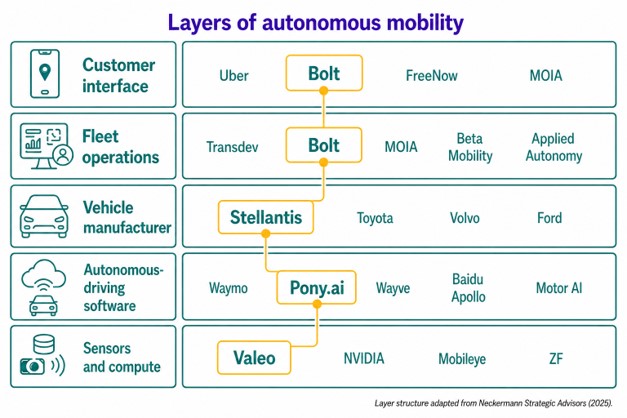
This vertical dis-integration changes who can be held to account. In a traditional taxi journey, responsibility is straightforward. In an autonomous platform service, one company may provide the driving software, another the vehicle, another the app, another the fleet operations, another the maintenance, and another the insurance. When a service fails, accountability has to be located somewhere along that chain, and the chain is rarely visible to the passenger.
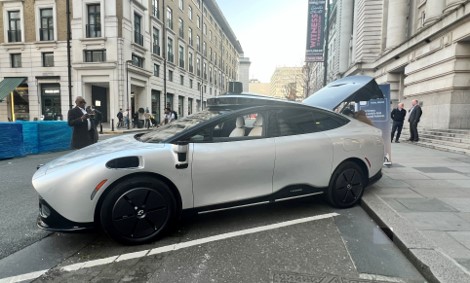
There is also a quieter divide running through the sector. Most autonomous vehicles in service today are conventional cars with autonomy added on top: a Waymo robotaxi is a Jaguar I-Pace with the Waymo Driver fitted. A growing number of newer vehicles are designed the other way around. The Zoox robotaxi, Baidu Apollo Go RT6, and the recently unveiled Tensor Robocar (Figure 3) are AV-first: their body shapes, sensor placement, interior layouts, and even the steering wheel are dictated by autonomy. Tensor is also making the opposite bet to most of the industry by aiming at private ownership rather than fleet operation (Tensor 2025).
For cities, this means that approving an autonomous service is no longer simply approving a vehicle. It is approving a set of arrangements.
The questions follow the technology
Whether the service is a Helsinki delivery robot or an Atlanta robotaxi, the same four questions follow.
The first is cost. A conventional car might cost around €35,000; a fully autonomous-capable fleet vehicle can cost several times that once sensors and compute are included. The premium is closer to the gap between a €30,000 Prius and a €250,000 Ferrari than between two versions of the same model separated by perhaps €5,000.
Beyond the vehicle, costs include sensors, software, mapping, connectivity, charging, maintenance, remote supervision, cybersecurity, insurance, and sometimes adjustments to streets and kerbside space. Industry discussions about scaling autonomous mobility often assume substantial public-sector contribution. The harder question is who captures the value once the service is running. If platforms, manufacturers and software providers retain most of the upside while cities carry the cost of the supporting infrastructure, autonomous mobility risks reproducing a familiar pattern in which public money subsidises private margins.
The second is trust. Public-acceptance research consistently shows that willingness to use autonomous vehicles is shaped by perceived safety, perceived usefulness, initial trust, and perceived risk (Othman 2021; Zhang et al. 2019). Trust is not a communication problem to be solved after deployment but a design and governance problem from the start. The systems that earn it are those that can explain themselves, be tested in advance, and be held accountable when something goes wrong.
The third is liability, closely linked to trust. The legal architecture for autonomous mobility is being written more slowly than the technology is being deployed, partly because there are very few decided cases. Insurers across Europe are watching the United States, where the first generation of significant AV liability cases is starting to work through the courts. People are uneasy at the idea of a person being injured by a computer rather than by another person, even when the underlying statistics suggest an autonomous system may, on the whole, be safer than a human driver. The structural concern is harder. In a collision between two human drivers, responsibility lies between individuals of similar standing. In a collision involving an autonomous vehicle, the injured party may face a manufacturer, a software provider, a fleet operator, and the operator’s insurer, each with significant legal resources. That asymmetry is itself a trust question.
The fourth is whether autonomous mobility delivers public value. The European Commission has noted that public-transport networks across Europe are already cutting services because of driver shortages, with routes withdrawn in evenings and weekends in some regions (European Commission 2025). Autonomous vehicles are not a complete answer, but they are increasingly considered as one tool, particularly for defined routes, depot operations, and low-demand connections. A recent literature review on autonomous buses cautions, however, that the implementation conditions are demanding, with barriers around public acceptance, traffic integration, regulation, and operational readiness (Hadid et al. 2025). Logistics and freight illustrate the same point differently: delivery robots, airport tugs, and depot or freight corridors often operate in environments more controlled than open city traffic, making them easier to scale. Privately-owned cars sit at the other end, where assisted driving is routine but full autonomy in unrestricted use remains unusually difficult.
Together, these four questions explain why autonomy is advancing unevenly: faster where the environment is bounded and the public-value case is clear, slower where the conditions are open and accountability is harder to locate.
Testing the future before building it
These are large questions, and not all of them can be resolved before deployment. Some can at least be tested in advance.
Simulation is an increasingly important part of autonomous-vehicle development, because real-world trials cannot cover every rare or dangerous situation a system may meet. Virtual environments allow developers to test vehicle behaviour, traffic interactions, weather, and sensor limits in scenarios that would be impractical or unsafe to stage on real streets.
For cities, digital twins add a further layer. They make it possible to compare service models and examine likely effects on congestion, emissions, kerbside use, and public transport before commitments are made in physical space.
A third use sits between technical validation and civic dialogue: immersive virtual environments and extended-reality (XR) tools that let people experience autonomous-mobility scenarios before they exist. A future bus route, a kerbside redesign, or an air-mobility corridor can be walked through in virtual form, at near-real scale, by people who would otherwise read the same proposal as a written document. This shifts the conversation from abstract description to direct experience, and turns a technical proposition into a discussable one before it becomes permanent infrastructure. It is a field in which Finnish research institutions and applied universities, including Metropolia, have been actively building tools and methods.
A transition built from many small things
The robot on the Helsinki pavement is still moving, indicators blinking, groceries inside. It is no longer the entire story. Behind it sit a Tampere bus on a feeder route, a drone above an Oulu test site, a Bolt customer tapping a button for a driverless ride, a regulator drafting a framework, an insurer recalculating risk, and a city authority deciding what counts as a public service.
In many forms, autonomous vehicles are already here. The more important question is no longer whether they are coming, but whether they will arrive in a form that is safe, useful, trusted, affordable, and aligned with public value.
Technology is only part of the story.
References
Cicek Simsek, D., Kantarci, B. & Schillo, S. 2025. A comparative review of user acceptance factors for drones and sidewalk robots in autonomous last mile delivery. Green Energy and Intelligent Transportation 4(1), 100310.
European Commission 2025. The road ahead: rethinking the future of transport jobs in Europe. News article. 27 November 2025. Accessed 2 May 2026.
FABULOS 2021. Future automated bus urban level operation systems. Accessed 2 May 2026.
Hadid, M., Irawan, M. Z., Parikesit, D., Firzan, F., Yunianti, N. H. & Widiastuti, N. O. 2025. Driving the future of sustainable public transport: a literature review on challenges and strategies in the adoption of autonomous buses. Discover Sustainability 6, 338.
International Transport Forum 2015. Urban mobility system upgrade: how shared self-driving cars could change city traffic. Paris: OECD/ITF. Accessed 2 May 2026.
metaCCAZE 2025. Tampere launches Finland’s first commercially operated automated bus route. Accessed 2 May 2026.
Milakis, D., van Arem, B. & van Wee, B. 2017. Policy and society related implications of automated driving: a review of literature and directions for future research. Journal of Intelligent Transportation Systems 21(4), 324–348.
mySMARTLife 2022. mySMARTLife: transition of EU cities towards a new concept of smart life and economy. Accessed 2 May 2026.
Neckermann Strategic Advisors. 2026. The ecosystem for shared autonomous mobility [Conference presentation slides]. European AV Summit 2026, London, United Kingdom.
Nysse 2025. Robottibussilinja 301. Accessed 2 May 2026.
Oksman, V. & Kulju, M. 2024. Towards sustainable mobility: public acceptance of automated last-mile deliveries. In: HCI International 2024 Posters. Communications in Computer and Information Science. Cham: Springer, 257–266.
Othman, K. 2021. Public acceptance and perception of autonomous vehicles: a comprehensive review. AI and Ethics 1, 355–387.
SAE International 2021. Taxonomy and definitions for terms related to driving automation systems for on-road motor vehicles. SAE Standard J3016_202104.
Sohjoa Baltic 2020. Sohjoa Baltic: automated electric minibuses for last-mile public transport. Accessed 2 May 2026.
Starship Technologies 2025. One million grocery deliveries completed in Finland with S Group. 11 December. Accessed 2 May 2026.
Tensor 2025. Tensor unveils world’s first personal autonomous vehicle for private ownership. Press release 13 August 2025. Accessed 2 May 2026.
UAM Oulu 2024. Urban air mobility Oulu. Accessed 2 May 2026.
University of Oulu 2024. Sustainable and autonomous carbon-neutral aerial ecosystems and energy solutions for future metropolises: AeroPolis. Accessed 2 May 2026.
Yuen, K. F., Cai, L., Lim, Y. G. & Wang, X. 2022. Consumer acceptance of autonomous delivery robots for last-mile delivery: technological and health perspectives. Frontiers in Psychology 13, 953370.
Zhang, T., Tao, D., Qu, X., Zhang, X., Lin, R. & Zhang, W. 2019. The roles of initial trust and perceived risk in public’s acceptance of automated vehicles. Transportation Research Part C: Emerging Technologies 98, 207–220.
Author
-

Janset Shawash
XR Expert and Project Lead, Metropolia UAS/HXRCJanset is an XR expert and researcher working on XR for cities, heritage, and creative industries, with a focus on accessibility and adoption.
About the author