These questions were at the centre of a recent R&D group project that was followed by a report at the Smart Cities in Smart Regions Conference in Lahti on 23–24 September 2026, focusing on exploring how to develop a Smart Campus concept for Metropolia.
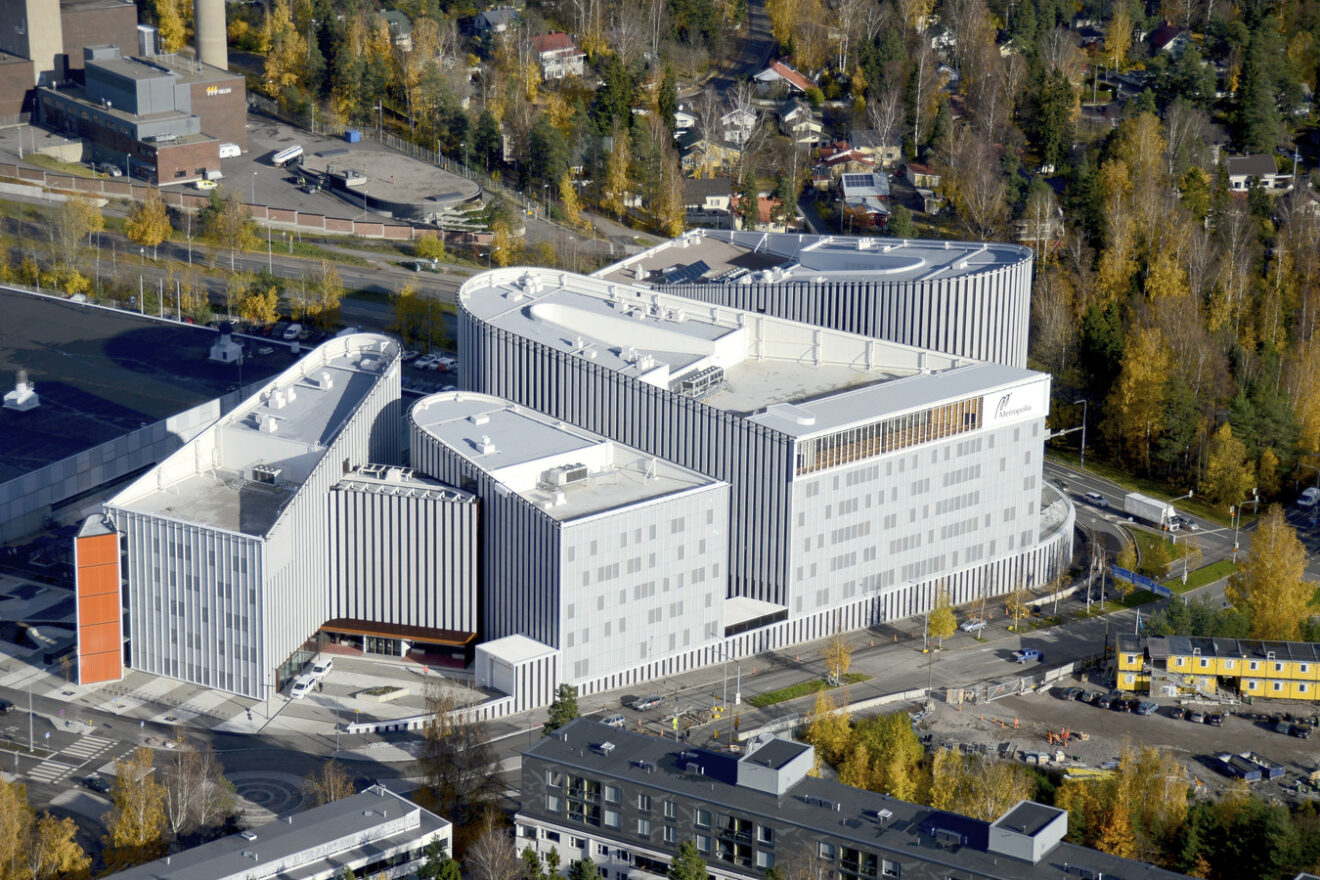
Metropolia’s Smart Campus is a living lab and ecosystem that originated from the planning phase of Myllypuro campus construction started in 2015. The planning was carried out in cooperation with the City of Helsinki’s planners and future campus users. The main goal was to create a new generation building for education, based on the ecosystem of innovation and research inspired by user needs. Such a smart campus was meant to provide opportunities for companies, education, research, and regional development to create smart building and facility management solutions for real-life situations.
Since its opening in January 2020, Myllypuro Smart Campus has become a home to more than 8000 students and over 600 staff members. It integrates advanced building technologies, automation, AI, and cloud services into teaching, research and development. Its idea is to enable students and researchers to co-create practical solutions together with companies in mutual learning.
What makes Myllypuro Smart Campus special is its technologies and relevant data. For example, building automation and IoT sensors measure the indoor environment and occupancy. Premises control with sensors maintains comfortable and energy-efficient conditions with the help of smart ventilation, heating and lighting control. Eventually, this information is visualised in a user-centric digital twin, accessible to every campus user.
Looking beyond technology
When talking about Smart Campuses, it is natural to focus on technology. Sensors collect information, buildings can respond to changing conditions, digital twins can provide a virtual representation of physical spaces, and AI can support analysis and decision-making. These technologies are important, but only part of the picture.
Recent research points out that a Smart Campus needs to combine technology with services, sustainability, user experience, organisational development and clear development goals (Dong et al., 2020; Polin et al., 2023). A campus may have sophisticated systems and large amounts of data, but if those are disconnected, responsibilities are unclear, or users do not know how they can benefit from them, much of its potential remains unused.
These ideas have become a starting point in discussions about the next step in Myllypuro Smart Campus development. Now, the current building blocks of the campus have been split into three dimensions related to (1) digital and physical infrastructures, (2) governance and strategy, and (3) service offerings and value creation (Gurudath 2026). These dimensions helped to look beyond individual technologies and sparked discussion about value creation by a wider Smart Campus ecosystem.
What Metropolia can learn from other Nordic universities
At first, benchmarks from other Smart Campuses and related practices were explored from several Finnish and Nordic universities. They were then narrowed down to the most innovative examples coming from Aalto University, Tampere University, the University of Oulu, KTH Royal Institute of Technology, the Technical University of Denmark and NTNU. The purpose was to understand a spectrum of different approaches and subsequently reflect these ideas against Metropolia’s context and needs.
The comparison showed that different universities approach Smart Campus development in different ways. Some have focused strongly on developing digital infrastructures and data, while others prioritise developing living lab environments, sustainability initiatives, research facilities, or closer collaboration with external organisations. Interestingly, the most compelling examples were not necessarily those with the greatest number of technologies, but those that connected technology with wider institutional goals and real activities involving students, researchers, staff and external partners.
Metropolia’s infrastructure is fit for a Smart Campus
Metropolia’s existing infrastructure is modern and diverse. Especially the Myllypuro campus has advanced infrastructure that includes smart building monitoring and sensing capabilities, with some 4000 temperature sensors and 150 wireless CO₂ and occupancy sensors. Energy and water consumption are monitored, and the campus has a rooftop weather station and capabilities related to weather-based AI control. These systems provide relevant information about the physical environment and how it is being used.
Another important element of Myllypuro Smart Campus is its Empathic Building digital twin environment. It provides a way of representing the physical campus digitally and connecting spaces with information such as occupancy, indoor conditions, navigation and other campus-related services. In addition, Metropolia has Smart Lab and Building Innovation Modelling (BIM) expertise, and applied RDI capabilities that enable experimentation and collaboration.
From capabilities to a Service Portfolio
The next development step was to list the currently available services and capabilities in Metropolia’s Smart Campus. This inventory work resulted in identifying nine groups of service areas that make up the Service Portfolio of Metropolia’s Smart Campus (Gurudath 2026):
- Data-as-a-Service
- Smart Building Testing and Experimentation
- Energy Efficiency Simulation
- Hyperlocal Weather Forecasting
- 5G Testing
- XR and Virtual Learning Environments
- Digital Twin and Smart Campus Visualisation
- Facilities and Laboratory Services
- Smart Mobility and Sustainable Campus Innovation
It is important to emphasise that these nine groups should not be understood as nine fully developed commercial products or services. They rather represent groups of available capabilities that may be developed. Moreover, the capabilities of different areas vary in maturity. Some capabilities are already supported by existing infrastructure and activities, while others require further development, integration, partnerships, or productisation. Yet this 9-group Service Portfolio clearly defines the service areas where Metropolia has mature existing capabilities and strong future development opportunities.
Metropolia’s Smart Lab and ‘campus as a living lab’
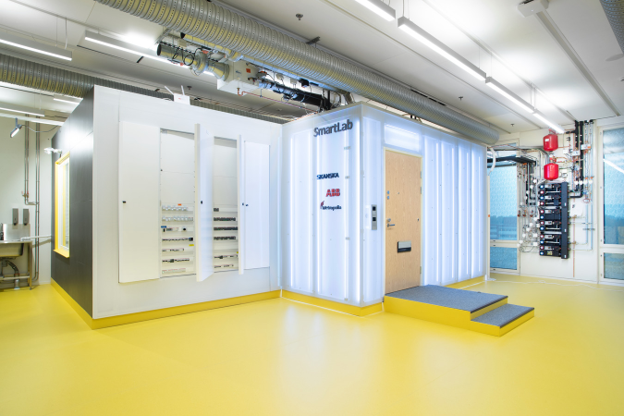
One of the capabilities that is particularly interesting and even special to Metropolia UAS is its Smart Lab. Smart labs provide environments where stakeholders can work together to develop and test solutions in real-life settings. Moreover, smart labs can connect to a wider conceptual idea of ‘a campus as a living lab’. This concept demonstrates what a university campus can provide better than a traditional laboratory: a real environment with real infrastructure and users that can address real challenges. University campuses with rich infrastructure and many real users can be of particular value as living lab environments. Their environments and users are part of education and research in their everyday activities (Nyborg, 2024; Stuckrath, 2025), and thus especially open and suitable for experimentation and co-creation.
For Metropolia, this ‘a campus as a living lab’ approach could create an even stronger connection between its Smart Lab and Smart Campus activities. In simple terms, instead of limiting technologies to its living lab, learning and research could extend to the campus level and become a place where these activities intertwine and support each other.
The way forward
Internal discussion about the development of Metropolia’s Smart Campus points towards several areas for future development. First, existing capabilities such as Smart Lab, digital twin and BIM could be developed towards marketable, also commercial services, making it easier for potential users and partners to understand what Metropolia can offer. Here, a practical step could be the development of a Smart Campus use case library. Instead of simply describing technologies or completed projects, such a library could show how the campus can be used for research, experimentation, and collaboration. It could also illustrate the Service Portfolio and provide potential partners with clear, concrete examples of what is possible.
Second, different ways to measure should be considered. A Smart Campus should not be evaluated only by the number of sensors installed or systems introduced. It is equally important to ask whether these investments improve learning, support research, contribute to sustainability, improve campus operations, and create new opportunities for collaboration. This is where a set of appropriate indicators can become useful, and there are already examples on how to do it (Polin et al., 2024).
Third, a more integrated approach to Smart Campus data could create opportunities for future analytics and data-driven services. Such governance becomes increasingly important as the number of systems, users and potential partners grows, and needs to progress in a coordinated way. One possible idea for this is the concept of an Applied Smart Campus Platform. Despite the name, it is not about creating another separate technology platform, butt bringing together the capabilities that already exist and making them visible and available for education, research, experimentation and collaboration.
These three directions are not mutually exclusive, but complementary. A digital twin, for example, has value only when it serves a purpose. Its value comes from its service of visualising the infrastructure and thus supporting teaching, research and building management. In the same way, sensor data becomes valuable when it helps to measure and thus support energy optimisation, research projects, learning activities or new data-driven services. The same applies to BIM, Smart Lab capabilities and other resources.
The question is not what these technologies can do, but how to make them visible and available for users to serve a variety of purposes. The model with these three development directions will further advance the Smart Campus ecosystem to become an environment where technologies can be ‘tested as a service’, data can be ‘analysed as a service’, ideas can be ‘innovated as a service’, and all those services can be clearly communicated, visible, and available. This is the area where a particularly strong potential has been recognised for the Smart Campus development at Metropolia.
Future of Metropolia’s Smart Campus that keeps learning
Myllypuro Smart Campus is already recognised by several awards such as the World Digital Built Environment (WDBE) Award 2023 for ‘Most Collaborative Use of Data’, a silver medal in the International Serious Play Awards 2024, and a Smart Building Gold level certification in 2024. The next level is to adapt these capabilities more deeply for education, research projects and industrial cooperation by advancing the Smart Campus ecosystem and user-friendliness of smart technologies.
As a result of the recent R&D group project, this direction was recognised as the main direction for Metropolia’s Smart Campus concept development. It is not simply about making buildings smarter, but about creating an environment where technology will be used to support learning, research, sustainability, collaboration and innovation. For Metropolia, most of the ingredients are already in place. The challenge is to connect them more clearly, build appropriate governance, and make it easier for people inside and outside the university to understand how they can participate and benefit.
Metropolia’s Smart Campus concept will never be a finished product. Technologies change, new user needs emerge and companies bring new challenges. A campus that can respond to these changes can become a long-term innovation environment rather than a one-time technology project.
With these ideas, the next step is to secure funding for the Smart Campus development in the upcoming EU Horizon Europe 2028–2034 funding programme for research and innovation. A special focus will be placed on the commercialisation and utilisation model for Smart Campus. In short, how can we turn the Smart Campus infrastructure and capabilities into a diverse portfolio of highly relevant, widely available – and also commercial – RDI services for companies and partners while benefiting Metropolia’s learners and Finnish society at large ?
References
Dong, Z.Y., Zhang, Y., Yip, C., Swift, S. and Beswick, K. 2020. Smart campus: definition, framework, technologies, and services. IET Smart Cities, 2(1), 43–54.
Gurudath, S. V. 2026. Developing “Smart Campus” Concept for “Smart and Creative City” Innovation Hub: Master´s thesis. Metropolia AMK. 93.
Nyborg, S., Horst, M., O’Donovan, C., Bombaerts, G., Hansen, M., Takahashi, M., Viscusi, G. and Ryszawska, B. 2024. University Campus Living Labs: Unpacking Multiple Dimensions of an Emerging Phenomenon Science & Technology Studies, 37(1), 60–81.
Polin, K., Yigitcanlar, T., Limb, M. and Washington, T. 2023. The Making of Smart Campus: A Review and Conceptual Framework. Buildings, 13(4), 891.
Polin, K., Yigitcanlar, T., Limb, M. and Washington, T. 2024. Smart Campus Performance Assessment: Framework Consolidation and Validation Through a Delphi Study. Buildings, 14(12), 405.
Stuckrath, C., Rosales-Carreón, J. and Worrell, E. 2025. Conceptualisation of Campus Living Labs for the sustainability transition: An integrative literature review. Environmental Development, 54, 101143.
Authors
-
Shree Vidya Gurudath
Master's degree studentAbout the author -
Zinaida Grabovskaia
Senior Lecturer at the Master´s degree programme in Business InformaticsAbout the author -
Harri Hahkala
Technology ManagerAbout the author -
Antero Vesterinen
Innovation DirectorAbout the author