Imagine this: the city announces a new development near your neighbourhood. Today, you might attend a town hall meeting, squint at architectural drawings, or scroll through a PDF on the city website. But what if you could walk through the proposed building before a single brick is laid? Stand on your virtual balcony and see exactly how it blocks the afternoon sun, then turn to your neighbour’s avatar (their virtual representation in the space) and say, “I think we should push back on this.”
Or go further. What if you could sketch your own counter-proposal in 3D, Minecraft-style, and share it with the planning department? Walk through flood simulations showing how climate change might affect your street in 50 years? Test whether the new library is truly wheelchair-accessible before construction begins?
Cities around the world are beginning to build shared virtual environments, sometimes called cityverses, where residents can explore, experience, and participate in urban life in ways that static plans never allowed. The question is no longer whether this will happen, but how, and for whom.
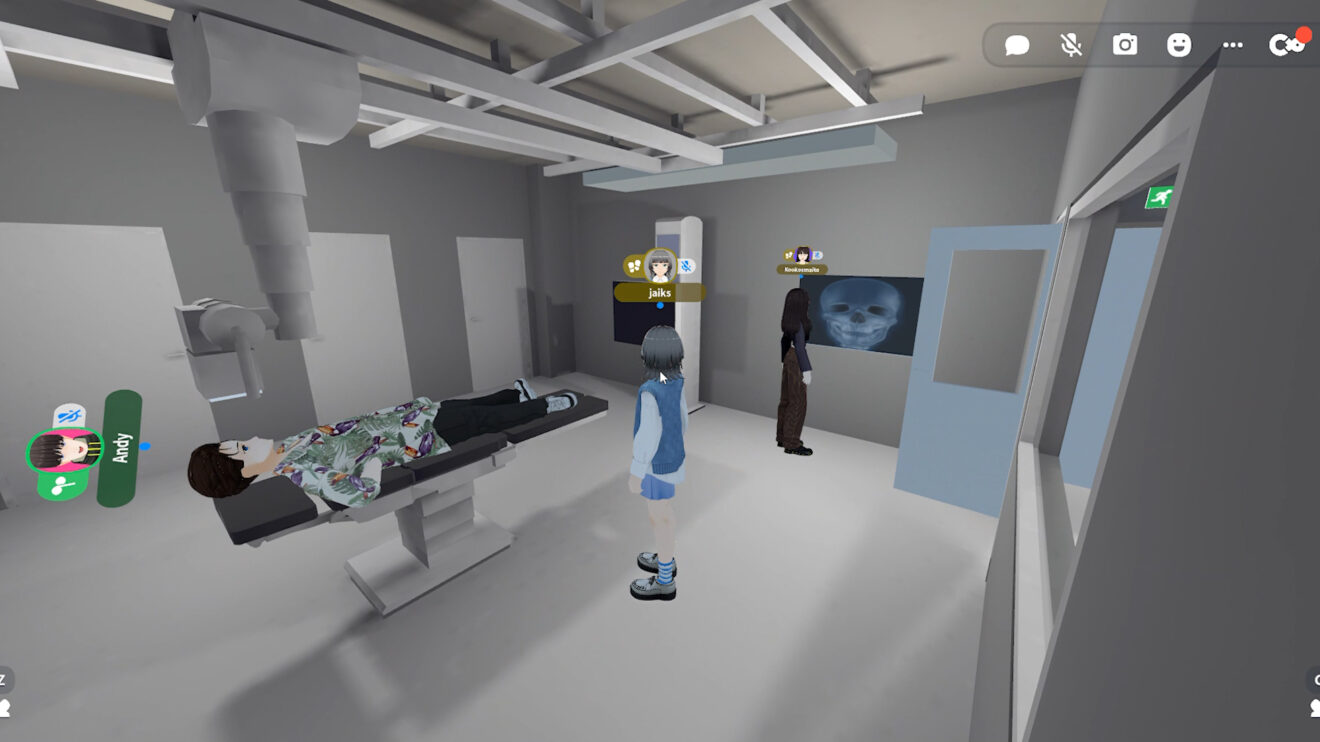
In this article, we trace the emergence of cityverse thinking from global experiments to Finnish initiatives, and share our experience building a proof of concept: Espoonlahti Health Centre in Espoo, brought into a social metaverse as a space for safety learning and civic connection (Image 1).
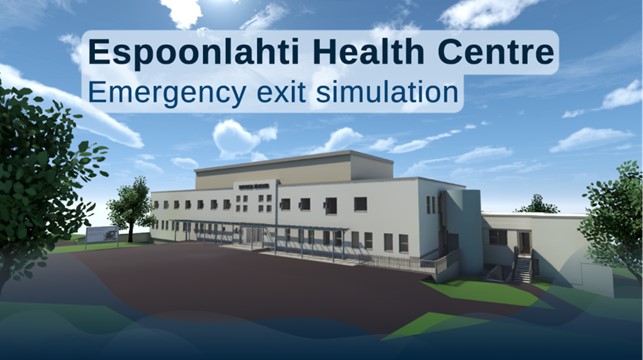
Image by Ella Räntilä.
Cityverses are emerging worldwide
The idea of a digital twin (a dynamic virtual replica of a physical place) has been around for years, mostly as a tool for engineers. What is new is the fusion of digital twins with social, immersive platforms where ordinary citizens can step inside.
Virtual Singapore has operated for nearly a decade, used for everything from smart energy planning to real estate development. Seoul has launched a metaverse for city services. Across Europe, a 2023 study found 135 local digital twin initiatives in 25 EU countries, with cities like Helsinki, Amsterdam, and Tampere exploring how these tools can support climate goals and citizen engagement (European Commission 2023).
What unites these efforts is a shift: digital twins are becoming shared spaces, cityverses, where data, avatars, and participation meet (Stardust Project 2023; Traoré et al. 2025). A 3D model you view alone is useful but limited. A space you enter with others: pointing at a proposed building, debating its impact, sketching alternatives together, changes the experience fundamentally. The conversation becomes embodied, spatial, shared.
This matters for accessibility too. You can join from home, from another city, or with physical mobility limitations. People who hesitate to speak in formal meetings may find it easier as avatars. And walking through a proposal makes complex spatial information intuitive in ways that drawings cannot (Dembski et al. 2020).
Cluster: where social meets industrial
This is where platforms like Cluster become significant. Cluster is a Japanese metaverse platform with over 35 million cumulative users and cross-device access (smartphones, PCs, VR headsets) meaning participation does not require expensive equipment. Originally known for social events and entertainment, Cluster has developed a strong industrial metaverse direction, supportingb building information modelling (BIM) and computer-aided design (CAD) data to build digital twins of real spaces (Kamegai et al. 2025).
Crucially, Cluster’s ecosystem connects to Japan’s Project PLATEAU, a national initiative led by the Ministry of Land, Infrastructure, Transport and Tourism that provides standardised 3D city models for approximately 250 municipalities as open data (MLIT 2024). PLATEAU frames these models as a kind of digital commons—public infrastructure that platforms like Cluster can build upon. Research using Cluster demonstrates that combining social metaverses with digital twins can create environments that enable democratic participation, moving beyond conventional expert-only systems (Kamegai et al. 2025).
Finland’s fast track
Finland has moved quickly on these ideas. In 2023, the Finnish Metaverse Initiative became the first of its kind in Europe, with Business Finland estimating the ecosystem includes over 250 companies (Business Finland 2023). The initiative emphasises ethical, human-centric development—a metaverse built on Finnish values of openness, trust, and accessibility.
At the municipal level, the FINverse national metaverse network, assembled under the InnoCities project, brings cities together to explore how immersive technologies can support urban planning, communication, and public engagement (InnoCities 2025). Cities like Espoo and Oulu are active participants, experimenting with what a Finnish cityverse might look like in practice.
The City of Espoo, in particular, has ambitions to extend its urban digital twin into citizen-facing environments. The Espoonlahti Health Centre pilot emerged from this interest—a concrete experiment in turning a public building into a shared virtual space.
Espoonlahti Health Centre: a proof of concept
Working with the City of Espoo and Cluster through the AI Start project, we brought the newly renovated Espoonlahti Health Centre into the metaverse. The experience is simple but vivid. You enter as an avatar and find yourself in a faithful recreation of the building: the lobby, the corridors, the cafeteria. The experience works across devices (smartphone, PC, or VR headset) so anyone can join regardless of equipment (Image 2). Press a fire alarm button on the wall. Suddenly, arrows light up on the floor, guiding you toward the nearest exit (Image 3). Follow them past the waiting area, down the corridor, out the door. At the meeting point outside, another avatar waves, maybe a friend who joined from across town, maybe a stranger curious about the same space.
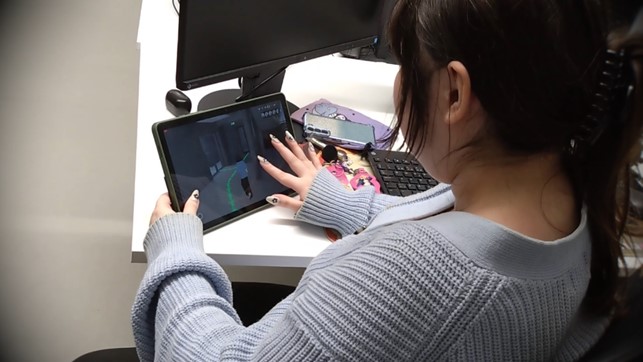
Image by Leevi Rantala.
The pilot focuses on emergency evacuation, transforming static safety information into an interactive, memorable journey. When you can walk through an evacuation route calmly from your sofa, the route becomes familiar before you ever need it in a real emergency (Espoon Sanomat 2025). But the social dimension matters as much as the safety content. The space is designed for gathering: resident meetings, safety workshops, community events. The threshold for participation drops when you can join as an avatar, from wherever you are.
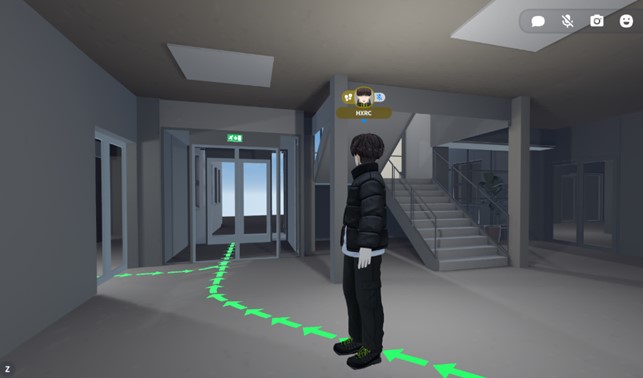
Image by Leevi Rantala.
The same approach opens wider possibilities. Residents could walk through proposed renovations, experience how changes affect wayfinding, or give feedback while standing in the virtual space. They could build their own proposals collaboratively. Newcomers to Espoo could learn the building before their first visit. Elderly residents who struggle to travel could attend community events as avatars. The building becomes not just a service point, but a civic platform. The finished simulation is available on Cluster’s website.
Building across language barriers
Producing the Espoonlahti prototype was a one-month sprint with a team of three trainees. The starting point was a Building Information Model (BIM) of approximately 6.3 million triangles, far too heavy for real-time rendering on a smartphone (Image 4). The team optimised it down to around 200,000 triangles, cleaned meshes in Blender, created textures, and implemented interactions using Cluster’s own scripting system.
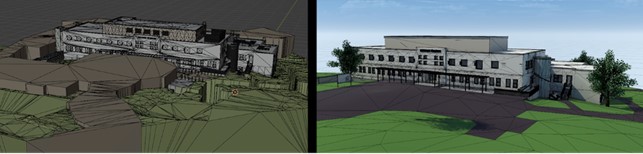
Image by Leevi Rantala
One unexpected challenge was linguistic. Cluster’s documentation and developer community operate primarily in Japanese. English materials exist but are limited, and when we hit technical blockers, the only active support came from Japanese-language Discord channels.
Here, one of our trainees—Andrii, a software developer—showed something we came to appreciate deeply. Without knowing Japanese, he used translation tools to ask questions in the community, navigating not just a technical problem but a cultural and linguistic barrier. The community responded helpfully, and progress resumed. It was a small reminder that building cityverses is as much a social endeavour as a technical one. Platform ecosystems are not only code and documentation; they are people, language, and willingness to bridge gaps.
What we learned and what comes next
The Espoonlahti pilot is modest: a single building, a focused use case. But it surfaced questions that will matter as cityverses scale.
Barriers persist. Device access, digital literacy, and language all shape who can participate. The fact that Cluster works on smartphones lowers one barrier; the Japanese-language community raises another. Small pilots like ours can surface these equity questions early, before larger investments are made.
The production pipeline from BIM to accessible metaverse is also non-trivial. Automated tools exist, but achieving both performance and visual quality on low-powered devices required significant manual work. As cityverses expand, this pipeline will need to become more streamlined, and more open.
Most striking was the potential beyond safety training: for participation, co-design, and genuine civic voice. The technology exists. The question is whether cities will use it to genuinely include residents, or simply add a new layer of digital spectacle.
For Espoo, the next steps include extending prototypes to other public buildings: schools, libraries, community centres; and connecting these metaverse experiences more tightly with official city processes. The connection between Espoo, Cluster, and the PLATEAU ecosystem in Japan shows how ideas and tools can flow across borders. Finnish emphasis on ethics and inclusion can inform how these platforms develop globally.
The next time you visit a public building, imagine exploring it virtually with neighbours, walking through proposals before they are built, knowing your voice shaped the outcome. That future is closer than it seems. The work now is to build it thoughtfully, and for everyone.
References
Business Finland 2023. Finnish Metaverse Ecosystem is the First in Europe to Create a Metaverse Initiative. Press release 1 December 2023.
Dembski, F., Wössner, U., Letzgus, M., Ruddat, M. & Yamu, C. 2020. Urban Digital Twins for Smart Cities and Citizens: The Case Study of Herrenberg, Germany. Sustainability 12(6), 2307.
Espoon Sanomat 2025. Espoonlahden terveysasema siirtyy metaversumiin. 12 December 2025.
European Commission 2023. Mapping EU-based LDT Providers and Users. Directorate-General for Communications Networks, Content and Technology.
InnoCities 2025. National Metaverse Network. Accessed 23 January 2026.
Kamegai, T., Miyata, S. et al. 2025. Implementation and Application of Multi-Format 3D Data Integration in a Cross-Device Commercial Metaverse Platform. arXiv.
MLIT 2024. Project PLATEAU. Ministry of Land, Infrastructure, Transport and Tourism, Japan.
Stardust Project 2023. Virtual Cities for Very Real Benefits: From Local Digital Twins to the Cityverse. 19 October 2023.
Traoré, A. et al. 2025. Integrating Social Dimensions into Urban Digital Twins: A Review and Proposed Framework for Social Digital Twins. Smart Cities 8(1), 23.
Authors
-

Janset Shawash
XR Expert and Project Lead, Metropolia UAS/HXRCJanset is an XR expert and researcher working on XR for cities, heritage, and creative industries, with a focus on accessibility and adoption.
About the author -

Leevi Rantala
Specialist, Metropolia University of Applied SciencesLeevi is a Technical 3D Generalist and Development Lead working at Helsinki XR Center. He also teaches Post-Production at Metropolia UAS.
About the author -
Alicia Sudlerd
Specialist, Metropolia University of Applied SciencesLead XR Developer at Metropolia UAS having Master's from computer science and game design background passionate to build engaging interactive solutions.
About the author