
Robotics is going through one of the most interesting periods in its history. The field has reached a point where artificial intelligence, affordable hardware, and powerful software are coming together in ways that enhance the performance of robotics in real life scenarios.
Mobile robots are navigating warehouses and hospitals, and quadruped robots are inspecting industrial sites. Collaborative robots are working alongside people on assembly lines. Behind all this, a new generation of artificial intelligence (AI) models is teaching robots to interpret the world and act in it with a flexibility that was unimaginable just a few years ago.
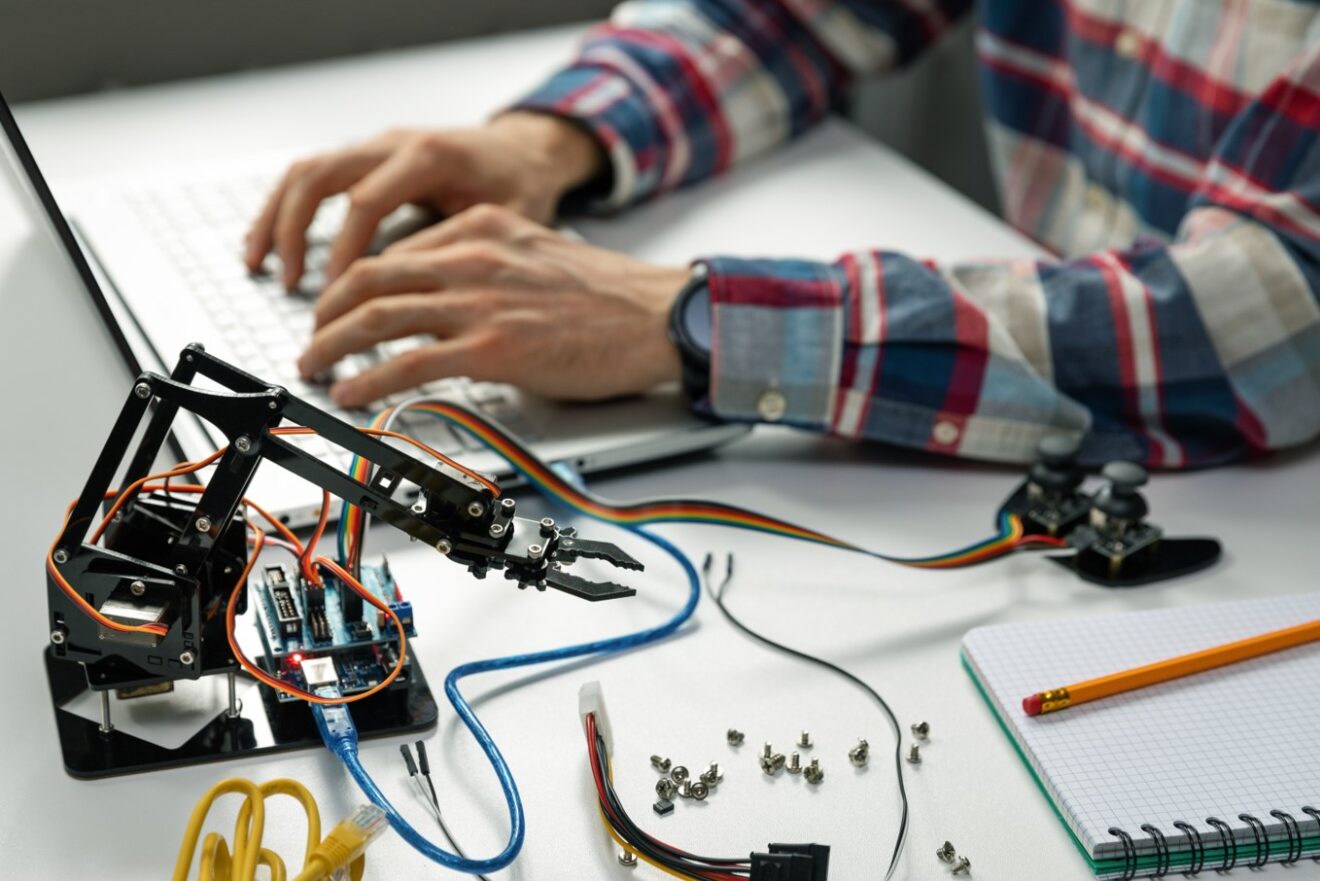
However, one part of robotics development has not kept pace: the way we test robots. Building a robot is easier than ever but testing one is not. Here is where robotics testing environments come in handy.
A testing environment is a space where robots can be measured and validated in action before they are trusted to work in the real world. Physical testing environment can be a room or an area that is shaped or includes obstacles, surfaces, and scenarios that mirror real conditions.
A digital testing environment is a simulated world in which a robot, or copies of it, can practise safely and at speed. In both cases the goal is the same: to give developers a controlled, repeatable place to see how a robot behaves, rather than hoping it performs once it is deployed.
The overlooked challenge in robotics development
Robotics discussions and development tend to focus on the robots themselves, what they can do, how they look, or how fast they learn. Far less attention is paid to the environments in which those robots are developed and trained.
A real world test is expensive in ways that are easy to underestimate. Hardware can be damaged, and spaces or platforms must be booked and prepared. Conditions cannot be exactly repeated from one day to the next, so results are hard to compare. Edge cases, which are the rare situations that matter most for safety, are difficult to reproduce. And the larger the development team, the harder it becomes to share a small number of physical robots without slowing everyone down.
Modern machine learning makes this problem even sharper. The kinds of AI models now being applied to robotics need to see millions of situations before they perform reliably. No physical robot can run that many experiments in reasonable time. One way to meet this demand is to move a significant share of testing into simulated environments, in which a robot, or many copies of it, can practise safely and at speed.
An infrastructural gap in the ecosystem
This need for permanent, well-instrumented testing environments has been recognised for some time, but the supply has not caught up. Most robotics companies cannot justify building a dedicated test facility on their own. Most university laboratories are not suited to industry-scale validation. The result is that every team tends to reinvent the same testing infrastructure in slightly different ways, and many promising ideas never get tested at the scale they need. (Mokhtarian et al. 2024.)
What is missing is something in between: shared, accessible environments where companies, researchers, and public sector partners can test autonomous systems under realistic and repeatable conditions. These environments exist, but they remain the exception rather than the norm.
A good testing sandbox is more than an empty digital room. It needs geometric variety (walls and other obstacles that genuinely exercise a robot’s navigation) along with diverse surfaces, known markers for perception, dynamic elements like moving people and other robots, and proper instrumentation that records ground truth and replays scenarios exactly. The most valuable sandboxes can be reconfigured to match the environments robots actually work in.
Robotics simulation environments
To understand what a robotics testing environment really involves, it helps to follow the process from the beginning. The starting point is usually an empty room or some other physical space, together with a robot and a problem the robot is meant to tackle.
The first step is to capture that space in a form a computer can work with. This is done through measurements, photographs, laser scans, and existing engineering 3D models, all combined to produce a digital model of the environment. The robot itself receives the same treatment, when its mechanical structure, sensors, and behaviour are described in formats the simulator can read.
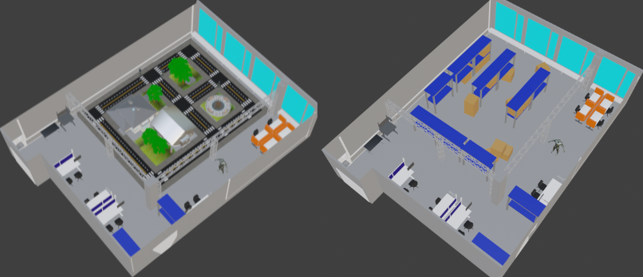
Next comes the choice of simulator. Several mature options are widely used today, each with its own strengths. Gazebo, in its current Harmonic release, is an open-source simulator closely tied to ROS 2 and well suited to mobile robotics and navigation work (Open Robotics n.d.). NVIDIA’s Isaac Sim emphasises photorealism and GPU-accelerated physics, which makes it a strong choice for generating synthetic training data and for projects with a heavy machine learning component (NVIDIA n.d.).
MuJoCo, originally developed for research and now open source under Google DeepMind, is known for the quality of its physics in manipulation and legged locomotion (Google DeepMind 2022). Webots is widely used in education and cross-platform development, and simulators built on game engines such as Unity and Unreal have become important in autonomous driving and aerial robotics.
Once a simulator is chosen, the environment is assembled inside it. The room is reconstructed from its meshes and materials. Physics properties are activated so that objects fall, slide, and collide in believable ways. The robot is brought in, its sensors are configured, and a communication bridge is set up so that the same software which controls the physical robot can also drive its simulated twin.
Now, the two versions of the robot can be compared, and the simulation can be refined until its behaviour matches reality closely enough to be trusted. When this loop is closed, a digital twin emerges: a virtual environment in which development can move quickly, and a physical environment in which the results can be verified.
Scale Down is a modular testing sandbox for robotics systems
Scale Down is a joint project between Metropolia University of Applied Sciences and Aalto University running from 2025 to 2027, which focuses on building a modular test environment for autonomous systems and mobile robotics that is safe, well instrumented, and suitable for both research and company testing.
Its key factor is modularity. Rather than one fixed layout, it can stand in for the different settings robots are deployed in, from urban streetscapes for outdoor mobility to warehouse and storage layouts for logistics, indoor office spaces for service robots, and industrial floors for manipulation (Metropolia UAS).
The project pairs a physical testbed, where robots run under controlled but realistic conditions, with digital tools that let scenarios be refined virtually first, with particular focus on fleet operations and networked perception. Supported by Metropolia’s Robo Garage and AIoT (Artificial Intelligence of Things) platforms it is open to companies, research organisations, and public sector partners. (Scale Down.)
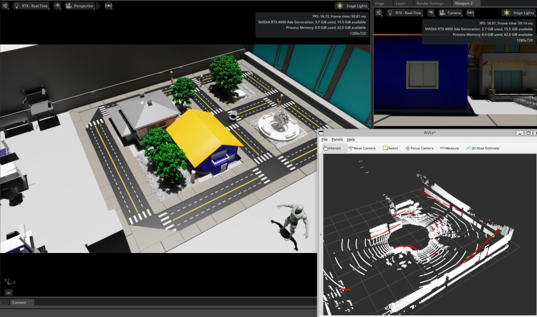
For startups and SMEs, that access can change what is possible. A small team can build a credible demonstration before committing to expensive hardware, show investors a working system rather than slides, and train engineers on its production software without waiting for a physical robot to be free. A simulated environment behaves predictably, and automated tests can run on every code change. Software development can progress in parallel with hardware rather than waiting for it, customer-specific deployments can be rehearsed before any installation begins, and integrators can show a client what a robot will look like in their space before a contract is signed.
We’ve reached a point where simulation is no longer a stage before the ‘real’ work; it is a permanent parallel environment, where the robot in the building and the robot in the computer inform each other continuously.
References
Google DeepMind 2022. Open-sourcing MuJoCo. Blog post 23 May 2022.
Metropolia University of Applied Sciences n.d. Scale Down. Project catalogue entry.
Mokhtarian, A., Xu, J., Scheffe, P., Kloock, M., Schäfer, S., Bang, H., Le, V.-A., Ulhas, S., Betz, J., Wilson, S., Berman, S., Paull, L., Prorok, A. & Alrifaee, B. 2024. A Survey on Small-Scale Testbeds for Connected and Automated Vehicles and Robot Swarms. arXiv:2408.14199.
NVIDIA n.d. What Is Isaac Sim? Isaac Sim Documentation.
Open Robotics n.d. Gazebo Sim. Gazebo Documentation.
Scale Down n.d. Scale Down – urban environment sandbox for developing swarm intelligence and mobile robots.
Author
-

Fayez Bassalat
Electronics Project Engineer, Project Engineer in TECHBOOSTFayez Bassalat is Electronics Project Engineer, who has worked as a Project Engineer in TECHBOOST.
About the author


