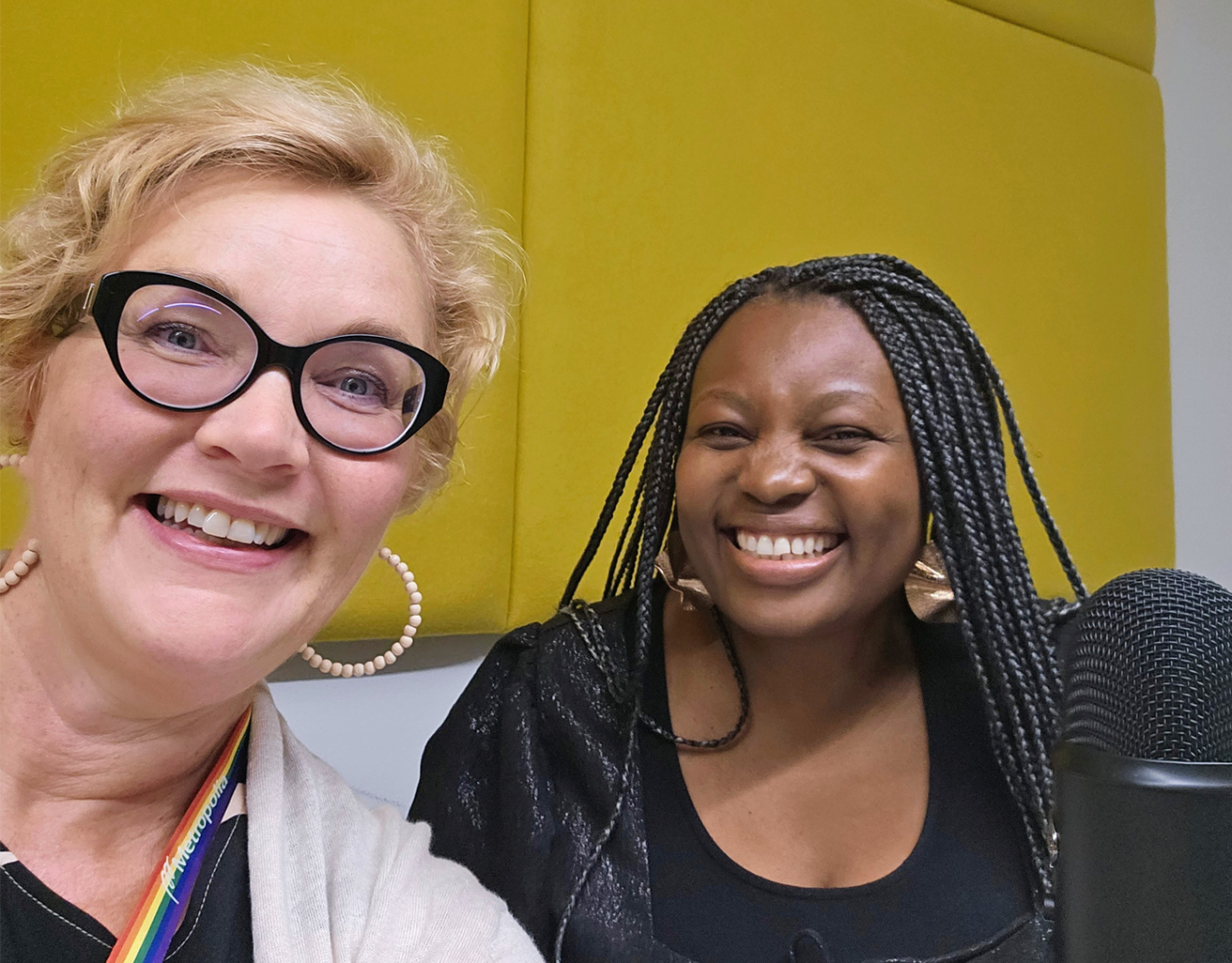
Heidi Rontu: Welcome to Diverse Metropolia, a podcast where we discuss different aspects of diversity as it is manifested at Metropolia University of Applied Sciences. My name is Heidi Rontu, and I work as Vice President of Education at Metropolia, and with me here in today’s episode is Eunice Siame-Moono, who works at Metropolia as an international student support and has a background spanning nursing, engineering, entrepreneurship and international education. Welcome Eunice.
Eunice Siame-Mooni: Thank you very much. I’m glad to be here.
Heidi: So let’s head on to our first question. Metropolia as a University of Applied Sciences has had diversity and inclusion on its agenda and as an important part of the university’s strategy for several years. How would you, Eunice, say it shows, if at all, to you as an employee now working with international student support at Metropolia?
Eunice: Well, yeah, [laughs] when you talk about diversity, it’s a huge topic and I’m glad that we are talking about that. I came into Metropolia as a student first, and then I retained as an employee. So I have two different perspectives of what diversity and how it looks like in Metropolia from a student point of view and as an employee.
Heidi: Precisely. Yeah.
Eunice: So when I talk about diversity and how it shows here at Metropolia, we have over a hundred nationalities here in Metropolia, and that already shows how the number of people who are in Metropolia, different backgrounds and different nationalities, it shows already at first glance. And then I would want to say when you talk about diversity, it’s not only adding different nationalities or having people with different backgrounds, but then you look at a whole holistic view of what diversity is. So that’s the point of view that I would like to dive into. Yeah. And then when you talk about inclusion, diversity and inclusion are two different things. Diversity of course is adding different kinds of people with different backgrounds, like I said, and then when you talk about inclusion, inclusion is more like adding value, allowing the people in that community to be able to voice out, to participate, to have responsibilities. And that’s one thing that I’ve noticed also in my own work, that I have responsibilities and opportunities to bring a different perspective and bring my own ideas to my work. So that way, if the question is saying, how do I see this diversity in Metropolia, it’s very vivid and it’s there and I can see it in my own life and my own experience here at Metropolia. I have had several opportunities as a student. I will start from there.
Heidi: Well, I was just actually, yeah, let me just, yeah, very good. I totally agree. So we should see diversity and inclusion as two different things, and perhaps it is the case that these sort of tend to get mixed sometimes. Now, you were coming into your own experience, and this is actually what I would very much like to hear. So in everyday life at university and now from an employee’s perspective, what would you say is important when we think about both actually diversity and inclusion?
Eunice: I will start by, since right now I would like to give both examples as a student before and when I retained as a employee. From a student point of view, only because right now, I’m working as an international student support, so students are at my heart and I do want to represent that following my own story. And I want to say that during my studies here, I had several opportunities because there was someone who had taken chance and time to speak to me, to show me what is the Finnish system like. People do not just assume that, oh, you know the Finnish system when you come to Finland, the Finnish education system, but somebody took time to explain those things. And so with that, it allowed me to approach people because then they opened that approachability. They were easily approachable and it was easy for me to get there and ask questions that I didn’t know.
Heidi: Yeah, because you knew the context, you knew how it works.
Eunice: Exactly.
Heidi: Precisely, and how you can work in the system.
Eunice: In the system, yes. And now as an employee, I look at my work as I’m guiding and integrating the students with different kinds of information. I see the small things that matter. It’s the person when the person comes from another country to Finland, to Metropolia, you first of all ask yourself, I’m here now and then what next. So that’s the opening. Is this person coming here, are they included in their decision making, in their thought lines, because then diversity is also a mindset. You need to think about it in that perspective that this person has never been here before, and they are here now, what’s next. The studies, the community in Metropolia. Are they welcomed. It’s not just welcome to Metropolia, but they need to feel they belong. So those are some of the things that I have seen as I work here and supporting the students that it’s the small things. I can say, welcome to Metropolia, but what do I do. Actions speak louder than words. So even in diversity and inclusion, that needs to show.
Heidi: Very, very wise words, I would say. Yes, precisely. And how would you say you have this experience as a student and now as an employee? Would you say that we have managed? If I understood correctly, you’ve had a good experience as a new student, so there were people who were helping you, explaining to you. What would you say, how are we doing this nowadays at Metropolia? Are we doing okay? How could we do it better?
Eunice: Yeah, well, I can say that we are doing okay, but we can do better.
Heidi: Yes. [laughter] I totally agree.
Eunice: There are several times that in my own work as a student support that students come with several questions only because there was maybe a language barrier. Finnish is very important in the workplace, in Metropolia. It’s a working language. So when the students come, the first question that they asked just recently in their orientation was like, how much Finnish do I need to know. What am I supposed to do for survival here if I can’t speak. So they already know that this is important. So when they come here, the important thing is not to make them feel little or that, oh, you are not speaking the language or anything, but then take the steps to educate, support, and there’s so much support here in Metropolia in terms of the Finnish language. The teachers are teaching the students Finnish, and at a higher level, Finland has so many opportunities for people to learn Finnish. And the only thing that we can do in Metropolia when we’re following this inclusive and diversity strategy is that it’s very important to understand that when somebody comes from a different country, they come with their own culture. So if we could meet in between. It’s a two-way process.
Heidi: This sounds interesting. I’ve been living abroad myself too, so I think I totally agree there. But could you give an example? Because this, I think, is very important that you also understand people coming from a different culture, that they actually do come from a different culture. You cannot assume things. How would you do this, meet sort of halfway? Could you give a concrete example of what it could be?
Eunice: When we talk about inclusion, we are looking at allowing individuals to be in front of their decisions, allowing them to speak up, allowing them to participate, allowing them to be responsible of themselves and their surrounding and in the community. And so in this community, you’ll find that when somebody comes from a different country, they have their own beliefs. They have the way they communicate. And then on top of that, they are coming to a whole different place. And then on top of that, there’s the language barrier, and that is something that scares everyone. I have gone through this when they talk about the culture shock. It’s very real. I’ve gone through it, and it’s not just because of the language, but just being away from home. It’s really, you need…
Heidi: It’s tough.
Eunice: Yes. You need that support and somebody to tell you that they can hear you, that you can listen and there’s someone who’s listening when you speak.
Heidi: It’s actually very much hearing and listening.
Eunice: Yes.
Heidi: That’s how you are meeting halfway.
Eunice: Half, yes. Because for example, in my work, sometimes the students that come here from their home country, they don’t speak English, but they have to study in English, for example. So then the languages that are used in Metropolia are Finnish and English, and if somebody can’t understand either or, then that’s a problem. How are they going to, yes, exactly. So then at that point, it’s very important, even as we move forward with our strategy that teachers and colleagues do not assume. For example, in the workplace, when you’re having meetings, there’s not supposed to be an assumption that everyone has heard what’s being told in the meetings. Not anymore nowadays, but before information is given in Finnish and then at the end, a summary in English. But nowadays, a lot of offices are bilingual. Even in my unit, it’s bilingual. So, when we’re in meetings, and I would like to say something, and then I’ll articulate my Finnish at some point, and then I will change to English. And so, we’ve accepted in my unit that we’ll have a bilingual meeting.
Heidi: Wow, that’s wonderful. Yes, sounds really good. I mean, this is a very good example, Eunice, that you are giving, because this is really an everyday life example, how you can make things a little bit easier for everyone when you are in a community as what Metropolia’s community also is, which I very much welcome, is becoming more and more diverse. This is a good example of that, yes. That’s one good example. What would you say, if we look at diversity and inclusion at Metropolia as it is now, and I think we agree that you can always do better, so how would you enhance diversity and inclusion at Metropolia? If you could give me some concrete things where we can do better.
Eunice: Okay. First of all, I think we should not ask questions or assume that people understand what is happening in this community but then we begin to give the platform to people to add value and speak up of what they need. Because when we are talking about how can we improve on this, we are looking at what somebody else is bringing to the community. We are in a community and if people need to feel that they belong to this community, then they should be able to speak up, they should be able to participate and be responsible of whatever it is that they are doing here. So firstly, I think we should begin to ask, how can we support you. So you don’t just bring it to them like this is what you should have, but then how can we support you.
Heidi: To you can actually ask and then you listen.
Eunice: Exactly. Listen, yes. Listening is very important and also to open up the networking in terms of the integration. When you talk about the language itself, Finnish language, in order for people to fully integrate into the Finnish culture, I think mixing Finnish people and foreign people would be one of the points that could be taken up seriously because even in terms of students, I work with students, some of them would ask why is it that they don’t mix with the Finnish students. So that’s one aspect in terms of students. Even to learn the language, I think if there’s more interaction with Finnish students and international students, that would probably bring about this belonging and they feel they can talk to anyone.
Heidi: Yes, and that’s actually a very good example. I do know that we have this mixing in some of our degree programmes, but I hear you, we are not doing it sort of holistically. This is, I think, a very good practical example where we can do better, sort of systematically see to it that there are these groups where both our national and our international students meet.
Eunice: Exactly.
Heidi: I think it should be easily done. Anything else that comes to your mind?
Eunice: And also in terms of when I’m talking about as an employee, from the employee point of view, I think collaborations and just opportunities that other employees are able to bring ideas to light and those ideas, they can actually see them happening in the university, then people would feel, oh, that was my idea and I can see that it’s happening. So I think it’s important the collaboration should not just be done by only the Finnish teachers but then together. I know in my unit, the teachers are Finnish teachers that teach in our unit and some of them are international teachers, so there is that collaboration because not one teacher teaches one class, but they collaborate. So that way that I can see definitely is happening, but if we could do it more and that it is vivid that people can actually put a finger to say this is happening in Metropolia. And it’s very important even the way we disseminate information. Yes. So the information should not just go in one channel but understand that people come from different cultures, so they understand things differently. The same way we come from different backgrounds, you will communicate to me something today, I might not hear it immediately. I have to think about it or something, but then I will get it eventually. So there are those small nuances that somebody is, you had the information, but to act on it, it takes a while based on maybe your culture or upbringing or anything.
Heidi: Or simply that you are in a new context…
Eunice: Exactly.
Heidi: …so everything is sort of a little bit different.
Eunice: But otherwise in terms of information dissemination, that’s the one part that I think we could enhance this inclusion in terms of including other nationalities into the community. We understand that the Finnish culture, I mean, we come into the Finnish culture and we need to integrate, but the integration only happens with a certain mindset, knowing that I can come here and you come, we meet at a certain point. I will hear what you have and hear what I’m saying, and then let’s see how we co-create. So I think it’s very important to understand that…
Heidi: It’s a dialogue. It’s a two-way street, you could say. I like that. I like that very much. Okay. Thank you, Eunice. I think we got a lot of good down-to-earth examples for how we can enhance still diversity and inclusion at Metropolia. I’m very happy that you are working here with us and for us also, and in your work also enhancing, I think in everyday work, every day you are enhancing diversity and inclusion here at Metropolia. So thank you, Eunice, and also thank you to all our listeners.
Eunice: Thank you so much for having me.
[music]
Featured in the podcast
-

Heidi Rontu
Vice President, Education, Metropolia University of Applied SciencesHeidi Rontu is responsible for education at Metropolia UAS.
About the author -

Eunice Siame-Moono
Trainee, Metropolia University of Applied SciencesEunice Siame-Moono works at the intersection of nursing education, AI, and inclusive learning, supporting international students in functionally bilingual programmes.
About the author


