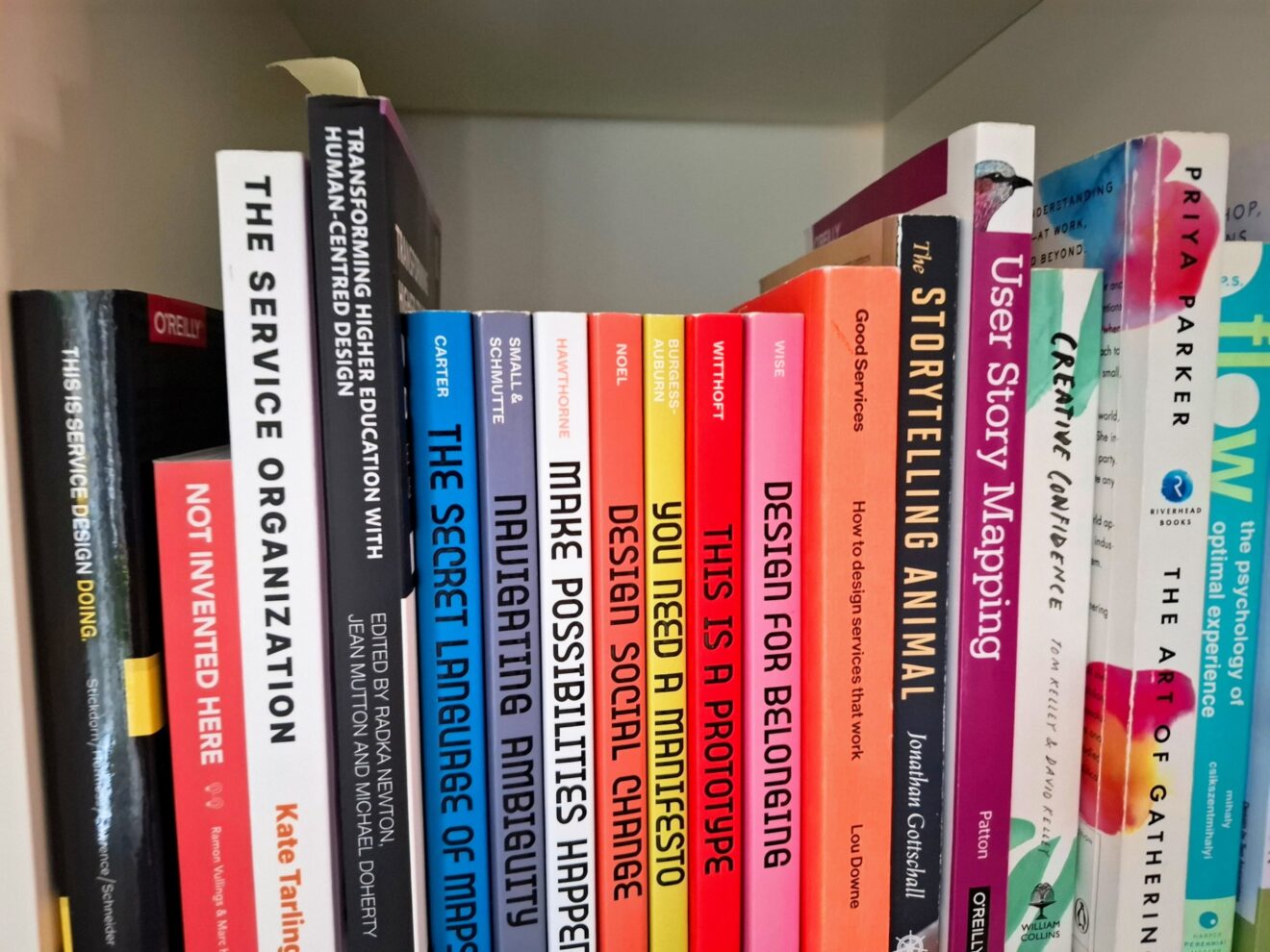
In December 2025 and January 2026, I ran a training to introduce university staff members to service design in the EIT HEI U!Innovate project. In the end, just over 100 people participated and completed this Introduction to Service Design training. Afterwards, when asked to identify one problem in their own institution that could benefit from service design, participants from across the project identified a remarkably consistent set of challenges.
Service design is a problem-solving methodology that aims to create usable, useful and desirable services in any kind of organisation. Universities are just one example. As major providers of services, they can benefit greatly from service design. What became clear from this roughly 100-point data set is that institutions from different countries, teaching different subjects and operating at different levels of higher education, still identified many identical broken processes.
The key aspect about services is that everyone needs them to complete almost any task. Lou Downe (2020) defines a service simply as “something that helps someone do something.” Her book, Good Services, is basically an instruction manual on how to assess and design services that work for people through 15 principles of good design. Therefore, it is not entirely surprising that many of the same processes appear across institutions, regardless of country or context.
As different as institutions can be, the underlying services necessary to run them are very similar. Students at every institution need to register for their courses, apply for mobilities, access their schedules, communicate with academic and professional services staff, access tutoring or health services, eat lunch, find accommodation, challenge grades and get supporting study documents among other things. Additionally, faculty and staff are users of services as well. Onboarding processes, salary payment services, communication portals, approval processes and such are all part of the staff experience in higher education.
In addition to asking about their own institutional problems where service design could help, the participants were also asked about three key takeaways from the training. Many highlighted a fundamental part of the service design process: resisting the urge to jump to solutions before the real problem has been defined. When services are hastily created after a ‘problem’ has been identified, what is really happening is that the symptom of that problem is being addressed and ‘fixed’. Not the real problem.
Participants in focus
The participants came from seven different countries and seven institutions, which were involved in a wide range of disciplines and services. They also represented many different roles – academic staff, professional services staff and experts – yet all pointed to similar problems. The fact that they experience similar problems in similar parts of their organisations points not only to individual failures of services but to systemic problems in how higher education services are designed.
Using the AI chatbot Claude to help group the problems listed by the participants, the outcome showed that there were roughly 19 specific problem areas that service design could help with which could be categorised into six broader categories:
- student registration and enrolment
- student and staff onboarding
- communication and information access
- administrative document and certificate processes
- coordination between academic and administrative departments
- student attraction, recruitment, and the applicant journey
A wide variety of services is offered under each of these six categories, rather than a single service. Each of these is an ecosystem if not multiple ecosystems.
Recognising the value of service design
During the assessment process of this training, each participant was asked to give one example of a problem in their institution that could benefit from the service design method. Even though answering this question was mandatory, there was also the option to write “nothing”. But none of them did. Instead, it seemed easy for them to identify opportunities for using this newly introduced methodology.
One of the main principles that service design teaches is that we should refrain from trying to solve the problem as we first see it. This may seem counterproductive, but it is understood that what we initially see is often just the outcome or a symptom of a deeper issue; not the problem itself (Wedell-Wedellsborg, 2017). Using the design thinking process, the participants learned that the first step is to explore the problem more thoroughly. To ask questions rather than jump to conclusions. To seek clarity of the experience of others (especially users) instead of relying solely on their own perspective.
The real reason these problems persist
In general, the most common way services are created, whether in universities, government, or other organisations, is from the inside out. A team identifies something that needs to happen, builds a process that makes sense to them, and then delivers it as is. What is often neglected is the experience of the person at the other end. Not through maliciousness or even carelessness, but because the pressure to act quickly leaves little room for the process which requires the slower work of understanding. This reflects a persistent goods-dominant assumption – that value lives in the service as delivered – rather than the understanding that value is actually co-created with the user in the moment of use (Vargo & Lusch 2004).
This latter mindset is visible in what participants listed as takeaways of the training. When asked for three key learnings, the responses clustered around six themes:
- shifting from assuming you know the answer to genuinely exploring the problem
- recognising that defining the right problem matters as much as finding a solution
- feeling that they are allowed to test ideas before committing to them
- understanding that good service design (and therefore good services) takes time
- that this time requires them to see the value of the feedback loop
- appreciating the specific tools that they had been introduced to.
Only one of these six top key takeaway themes is based on the tools that were taught during the training, and this is almost as an afterthought. The others are all about mindset. This tells us something important about what is getting in the way.
People working in higher education in the 2020s are operating in high-pressure, high-volume environments where knowing is valued over learning, quick answers are valued over careful questions, and implementation is valued over iteration. These are not character flaws. They are the natural response to working institutions that move faster than before and measure output in quantifiable ways. But they are exactly the conditions that produce services around organisational convenience rather than human experience. They are the conditions that create a sense of haste about renewal while very little actually changes.
There is a particular irony here. Universities are institutions built on the idea that understanding something properly takes time, that evidence matters, and that conclusions should follow from careful inquiry rather than precede it. These values are extended generously to academic research. They are rarely extended to the professional services staff who are responsible for the experience of every student and colleague in the building. The same rigour that a higher education institution applies to producing knowledge could be applied to designing the services that deliver it. Until it is, the same broken patterns will keep appearing across departments, across institutions, and across borders.
What upgrading service creation looks like in practice
To upgrade service creation in the higher education sector across Europe, professional services staff and those creating services need to be allowed the time to do the necessary human-centred research that is required to understand the users and to define the problem correctly. They also need an environment that embraces learning and iteration. This, in turn, demands a little more patience from these organisations. Patience in the beginning will inevitably save them time, money and other resources in the long run, when the service is implemented correctly instead of just quickly.
To truly understand the issues users are experiencing, we need to find out if they are isolated incidents or shared problems, and to see what the wider ecosystem of services looks like and how those services are interconnected. Often, services are created in isolation when, in reality, they are part of a plethora of services that feed into and out of each other. Students who want to register for classes also need to gain access to the course catalogue, to the timetable, they may need to set up a meeting with the lecturer, sign into the LMS that the institution uses and so forth. Each one of the services created at an institution is part of a broader ecosystem of services, drawing on many different units, individuals and faculties to deliver it.
What next?
The fact that institutions across seven countries named the same broken services is not a coincidence. It is a pattern. And patterns can be fixed.
This is good news. If the problems are shared, the approach to solving them can be as well. Service design is not a specialist discipline requiring expensive tools or outside consultants. It is a learnable process (Stickdorn, Schneider, Andrews, & Lawrence 2011) – one that any team, in any unit, can apply to the services they are already running. Universities that invest in training their own staff to use it will spend less time and money fixing services that were never quite right to begin with.
The broken places are the same. That means we already know where to start and we have a method that works differently in every context it is applied to, because the solution always comes from the people it is designed for.
References
Downe, L. 2020. Good Services: Decoding the Mystery of What Makes a Good Service. Netherlands: BIS Publishers.
Stickdorn, M., Schneider, J., Andrews, K., & Lawrence, A. 2011. This is Service Design Thinking. Hoboken, NJ: Wiley.
Vargo, S. & Lusch, R. 2004. Evolving to a New Dominant Logic for Marketing. Journal of Marketing, 68(1), 1–17. https://journals.sagepub.com/doi/10.1509/jmkg.68.1.1.24036
Wedell-Wedellsborg, T. 2017. Are you solving the right problems? Harvard Business Review 95(1), 76–83. https://hbr.org/2017/01/are-you-solving-the-right-problems
Author
-

Pamela Spokes
Specialist, Metropolia UASPamela Spokes BA, MA, MBA, AmO. Educator in Service Design and Entrepreneurship with the Turbiini Pre-Incubator Programme in English.
About the author