Traditional higher education methods are not equipping students with the innovation skills that our fast-changing world requires of them. Conventional classroom teaching transfers subject-specific knowledge effectively, but not power skills – also referred to as ‘soft skills’ (Wells 2024) – required by real-world challenges and workplace realities. Rarely are students required to collaborate across disciplines or with peers whose knowledge gap is significantly different to theirs. Nursing students and engineering students rarely interact in formal classes, although such collaboration is required in the ‘real world’.
Building a traditional course where future engineers and nurses would be learning something together could be difficult. This is where challenge-based learning (CBL) shines. It has come out precisely of these needs to equip students not just with theoretical knowledge about how things work, but with an arsenal of applied tools to work with diverse groups and in real world scenarios.
The World Economic Forum Future of Jobs Report 2025 lists 26 core skills that they can see evidence for. It is easy to identify eight (those in bold) of the top 12 skills that are supported by CBL by combining learning by doing with collaboration in teams to face challenges together:
- Analytical thinking
- Resilience, flexibility and agility
- Leadership and social influence
- Creative thinking
- Motivation and self-awareness
- Technological literacy
- Empathy and active listening
- Curiosity and lifelong learning
- Talent management
- Service orientation and customer service
- AI and big data
- Systems thinking
Challenge-based learning means shared learning by doing
Challenge-based learning is rooted in Kolb’s (1984) Experiential Learning Cycle which moves between concrete experience, abstract conceptualism, active experimentation, and reflective observation.
The concept of challenge-based learning began to be published later than Kolb’s framework. It was first referenced by that name in a paper presented at the American Society for Engineering Education Annual Conference & Exposition (Giorgio & Brophy 2001). CBL is also strongly linked to the Apple Classrooms of Tomorrow-Today (ACOT²) concept published in 2008 (Nichols & Cator 2008).
Malmqvist et al. (2015) defined CBL as ‘a learning experience in which learning takes place through the identification, analysis and design of a solution to a socio-technical problem’ and they continued on to say that it is ‘typically multidisciplinary, takes place in an international context and aims to find collaboratively developed solutions that are environmentally, socially and economically sustainable’. This has continued to be a solid and recognised definition even today.
With this history and definition in mind, we can also use the Taxonomy of Significant Learning (Fink 2003) to understand the depth of learning that happens during a U!REKA Change Agents CBL course. This framework offers six dimensions of meaningful educational experience that can be measured:
Before the in-person Helsinki week, the students were already building foundational knowledge through the mandatory online sessions with experts in each year’s theme. The experts are sourced from the same institutions that send students. In 2025, this included experts in social sustainability, waste management, and smart city development. This gave the students enough grounding to engage meaningfully with the challenge presented to them without prescribing how they should solve the problem.
The knowledge that the students gathered was immediately applied as they mapped their competences in their initial team meetings and discussed how what they learned related to the theme. Once in Helsinki, they were able to apply many new learnings, such as those required in the design thinking process, and put them into application through user interviews, desk research, and testing assumptions with real people. They continued to do this with their prototyping efforts and gathered testers for those prototypes. Physically making prototypes allowed them to continue their learning by doing as realistically as possible.
As intended in the design, each team was constructed to be a mix of cultures and disciplines. The integration of the students happened naturally, but not always without issues. Students from very different backgrounds developed a wide range of concepts they were able to add, based on their specialist knowledge or their insights as users of services and products. They were able to share perspectives and learn from each other, allowing them to build a new kind of thinking that they would not necessarily develop in their own mono-disciplinary classroom.
The human dimension was built into the programme from day one and it could be considered one of the most important reasons to arrange this course. In the earlier online sessions where the students were asked to map their own cultural expectations and communication styles, they also were expected to talk about how they would like to deal with the problems. As a result, they come to the event with the understanding that miscommunications or even different values may be an issue; but an issue that is part of the process.
The development of genuine new values and perspectives, caring, happened naturally in this environment. Exploring challenges through multiple perspectives and intercultural lenses meant that students were seeing ideas through the eyes of someone from other places. They needed to ask if their solutions would work in Lisbon, in Ostrava, in Belgium, or elsewhere.
The final of the six dimensions, learning how to learn, showed itself in an unexpected way in the students’ everyday communications. Since the entire programme runs in English, no participant was working in their own language. Rather than becoming a barrier, it became a shared condition. Each participant, with varying levels of English, had to try to be understood. Trying became the triumph and trying one’s best was the norm. Teammates naturally helped each other out to find the right words when help was needed.
The Change Agents course not only allowed students to learn skills that are prevalent in Fink’s framework but also to develop actual innovation skills needed for challenge-based learning.
The innovation skills that CBL builds
When we break down the skills required in CBL, we can see five different skills that are required and exercised:
Interdisciplinary thinking requires that the group understands everyone’s different strengths. If the group has been carefully assembled with their study fields being considered, then it is possible that they can tap into multiple perspectives on how the problem could be understood and considered as well as how the solution should be assessed.
Self-directed learning is required when working in teams with more complex problems. This in itself requires the skills of curiosity and the ability to break down problems into more manageable elements. This allows the teams to make sure that everyone can be involved and that they share the work to move ahead faster.
Problem-centred thinking contains many different skills to be exercised by CBL: creativity, flexibility, iteration, and resilience are the main ones. Keeping the problem at the centre throughout both exploration and solution is essential to actually solving it. It means that no individual solution may be the answer and the flexibility of the group is needed, to change the solution if it doesn’t perform well. That requires the group to be creative in their thinking and approach, flexible in their willingness to be wrong, and resilient enough to repeatedly try to get it right.
Communication skills that are required span from active listening skills to everyday communication and public speaking. The students need to listen to the issues that the problem causes and to those who experience them. This means to listen for understanding, not listening to respond. Then they need to practice the ability to talk constructively to their team members if conflicts arise but also just to build concepts and solutions. In the end of the process, they will be required to present their solution to either the other teams and the teachers, or possibly to other stakeholders and people they have not met.
Human-centred approaches and systems thinking requires all the participants in CBL to use a systems approach that is centred on the human experience. It will not be a good solution if it technically works but is not usable or desirable by the people who would need to use it. It would also not be a good solution if it just solved that one problem, not recognising how it may affect other issues in the users’ lives.
Those running the CBL experience may also choose to add in cross-cultural collaboration to formulate teams that come from different cultures to work together on the U!REKA Change Agents course. All of these skills are well represented among the top 12 skills of the future (World Economic Forum 2025).
U!REKA Change Agents programme is the European model for CBL
As of 2025, the European Commission has facilitated the creation of 65 European University Alliances with a total of 570 educational institutions. U!REKA is one of these, with an aim to work collaboratively within the partner network around the specific themes of digital transformation and smart cities.
The U!REKA Change Agents course, an annual Blended Intensive Learning (BIP) course that combines both physical and online learning, was created through this collaboration. For the past four years, the U!REKA alliance has run these courses, hosted on a rotating basis by participating partner institutions. An official BIP in the European context must include at least three higher education institutions from three different Erasmus+ countries, and the participants are students from these institutions. Building BIPs with our U!REKA partners supports the development of each institution’s curriculum. It is also a perfect opportunity to meld challenge-based learning with other skillset-enhancing experiences such as international collaboration and building a European identity.
These courses that connect students, lecturers, and other partners allow us to build useful and attractive challenge-based learning opportunities that are also impactful. Having students come together to work on real life problems that the cities have defined helps them connect to others both as learners and as Europeans.
Helsinki 2025: CBL in action
The 2025 edition of Change Agents was held in Helsinki and hosted by Metropolia University of Applied Sciences. It included 33 students and five lecturers from seven institutions representing diverse subjects from aviation, business, finance & economics, engineering, construction & technical fields, ICT & computing, and social sciences & human services.
Over three online sessions, students first met their teams, learned more about the course and its expectations, studied the design process, learned the fundamentals of pitching as well as took part in lectures that were specific to the broad theme ‘Climate neutral and smart cities’.
While in Helsinki, students from the six different countries not only got to experience Finland in May, but also experienced Finnish culture on public transportation, in work settings, and in education settings. They also visited the Helsinki Region Environmental Services Authority to experience how Finland does recycling and waste management. The students worked on two of Metropolia’s campuses in Myllypuro and Arabia experiencing their facilities for student collaborative work.
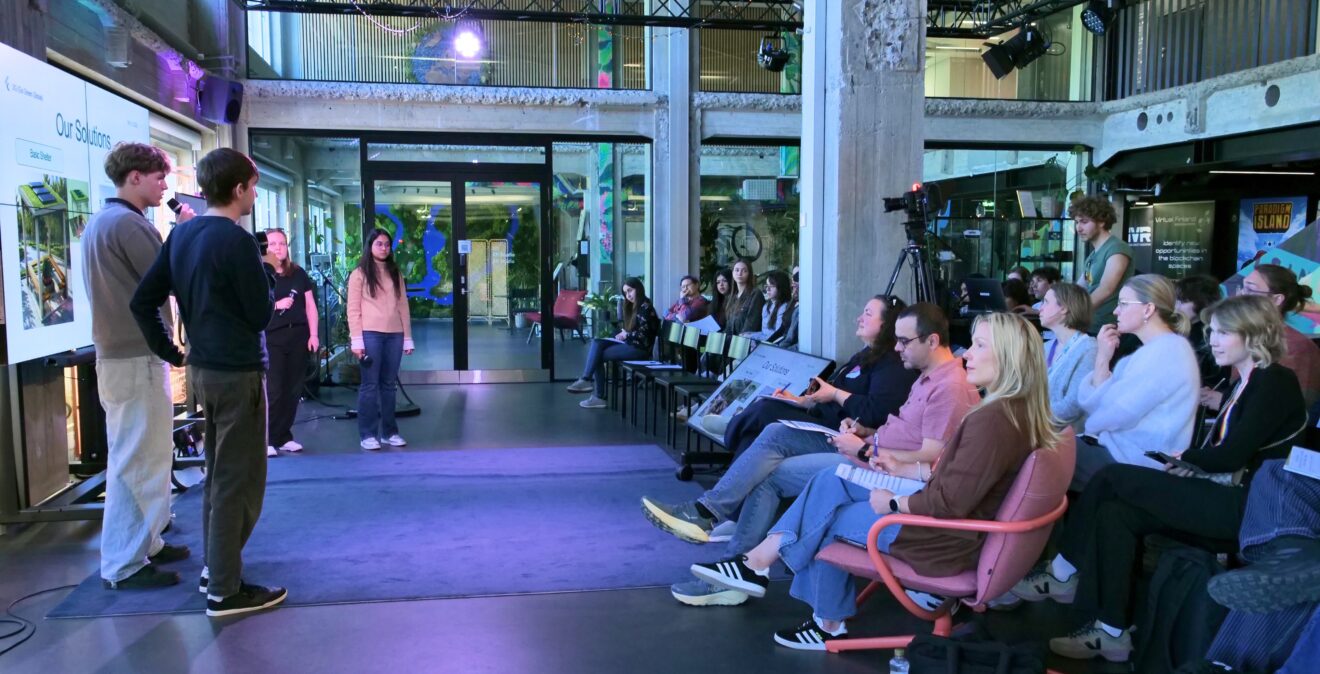
Working together, the students conducted user interviews for their ideas, built prototypes out of physical and digital materials, recorded videos of their concepts in use and iterated their ideas over the week. In the end, they presented their final tested concepts to a large group of staff from the concurrent U!REKA Connects conference that was taking place at the institution. They had three minutes to pitch their solutions to a large audience of people they did not know. This was nerve-wracking for the teams but helped with their final presentations immensely. It was challenging in a good way for each team. What happened in Metropolia was not just students learning the difference between a pitch and a presentation, it was evidence of what innovation skill development actually looks like in practice.
Calling European institutions to rethink how we teach for innovation
The students who attend the U!REKA Change Agents course are fully engaged and dedicated to their learning. They know that they only have a limited amount of time to make an impact. It is exciting to see how they come together as teams and as a larger group in this short international challenge-based learning environment. They are learning inside and outside the walls of the classroom. Adopting new and non-traditional learning experiences enriches student experience and learning in so many ways. Some of them are not even measurable. They are learning how to create innovations while having fun, learning new things, and meeting new people.
Employing such experiences can be created at any institution. They will take a little more collaboration between departments or faculties but this will lead to richer learning and development for both the students and the institution itself. The skills learned are exactly the skills that these students will need to work in a world that is different to the one we entered after leaving university. We cannot continue to only teach in the same ways as in the past.
Challenge-based learning is not just nice to have in 2026 and beyond. This kind of teaching and learning that develops the five to six skills mentioned above is now a necessity. There is a gap between what students can learn in single faculty courses and what they learn in multi-faculty environments. These multi-faculty courses are needed so that students are able to hear different perspectives to identify and connect the complex problems to wider society. None of us lives in a world where we are only surrounded by one kind of knowledge or way of seeing the world.
At the writing of this article, the 2026 edition of Change Agents has just concluded, once again hosted by Metropolia, with the 2027 editions already being planned at a partner institution. This is evidence that this model is not just replicable but building momentum across the alliance. Having the opportunity to work in these environments prepares students for the complexities of issues and life beyond the institution’s walls. U!REKA Change Agents is a great example of how challenge-based learning can look like in practice. If your institution is not running something like this that is available to all students from any faculty, then maybe this is your sign to start one of your own now.
References
Fink, L. D. 2003. Creating significant learning experiences: An integrated approach to designing college courses. San Francisco: Jossey-Bass.
Frank, F. & Hogendoorn-Schweighofer, P. 2026. Erasmus+ Blended Intensive Programmes’ role in promoting inclusivity and sustainability in management education – A survey-based evaluation. The International Journal of Management Education, Volume 24, Issue 2, 2026.
Gallagher, S. E., & Savage, T. 2023. Challenge-based learning in higher education: An exploratory literature review. Teaching in Higher Education, 28(6), 1135–1157. Accessed 30 March 2026.
Giorgio, T., & Brophy, S. P. 2001. Challenge based learning in biomedical engineering: A legacy cycle for biotechnology Paper presented at 2001 American Society for Engineering Education Annual Conference & Exposition 24 June 2001. Albuquerque: USA. Accessed 30 March 2026.
Kolb, D.A. 1984. Experiential learning: Experience as the source of learning and development. Prentice-Hall, Inc. Englewood Cliffs, NJ.
Leijon, M., Gudmundsson, P., Staaf, P., & Christersson, C. 2022. Challenge based learning in higher education – A systematic literature review. Innovations in Education and Teaching International, 59(5), 609–618. Accessed 28 March 2026.
Malmqvist, J., Rådberg, K.K., Lundqvist, U. 2015. Comparative analysis of challenge-based learning experiences at three European universities. Paper presented at the 11th International CDIO Conference 8 June 2015. Chengdu: China. Accessed 28 March 2026.
Nichols, M. H., & Cator, K. 2008. Challenge based learning white paper. Cupertino, California: Apple, Inc.
Spokes, P. 2025. Students with a vision for climate-smart cities: Co-creating the future in U!REKA. Published 24 June 2025. Metrospective Pop.
Wells, R. 2024. Soft Skills Vs. Power Skills—Is There a Difference? Published 19 February 2024. Accessed 19 April 2026.
World Economic Forum 2025. Insight Report: Future of Jobs Report 2025. Published 7 January 2025. Accessed 24 January 2026.
Author
-

Pamela Spokes
Specialist, Metropolia UASPamela Spokes BA, MA, MBA, AmO. Educator in Service Design and Entrepreneurship with the Turbiini Pre-Incubator Programme in English.
About the author