
Collaboration is at the core of RDI partnerships
Addressing complex phenomena in a constantly changing world requires recognising diverse expertise and integrating them in new ways. No single actor is any longer capable of responding to intertwined challenges alone. The collaborative RDI activities and processes are the context in which novel solutions emerge.
Our article is anchored in the development of RDI activities at Metropolia University of Applied Sciences. As a solution-driven institute of learning, Metropolia’s phenomenon-based RDI activity model is grounded in its interpretation of the Quintuple Helix framework. The model highlights interactive and systemic collaboration, and the strong interconnection between academia and practice. At its core is collaboration among societal systems to address challenges in a sustainable way. This broad ecosystem-based approach differs fundamentally from traditional bilateral cooperation. (Huhtaniemi & Vilkuna 2025.)
Collaborative RDI activities, however, do not arise automatically and can be based on many different needs, such as strategic partnerships or impact-driven partnerships. Our particular interest lies in reciprocal collaboration that enables equal participation grounded in goodwill. It is collaboration that generates sustainable wellbeing for its participants and enables collective lifelong learning. In this way, we will construct the RDIL (research, development, innovation, learning) framework as an integrated whole in the conclusion of our article.
The concept of co-curiosity in the context of RDI activities has evolved within the RDI profiling process of Metropolia University of Applied Sciences (2021–2024). The evidence-based process resulted in a Futureproof RDI Partnership culture and a Participatory RDI Partnership model and evaluation framework to build reciprocal partnerships in collaboration for sustainable transformation (Picture 1). In participatory research partnerships, emphasis is placed on enabling equal participation in interaction for all. This includes recognising each contribution as valuable and essential to achieving the shared goal. (Sipari et al. 2024.)
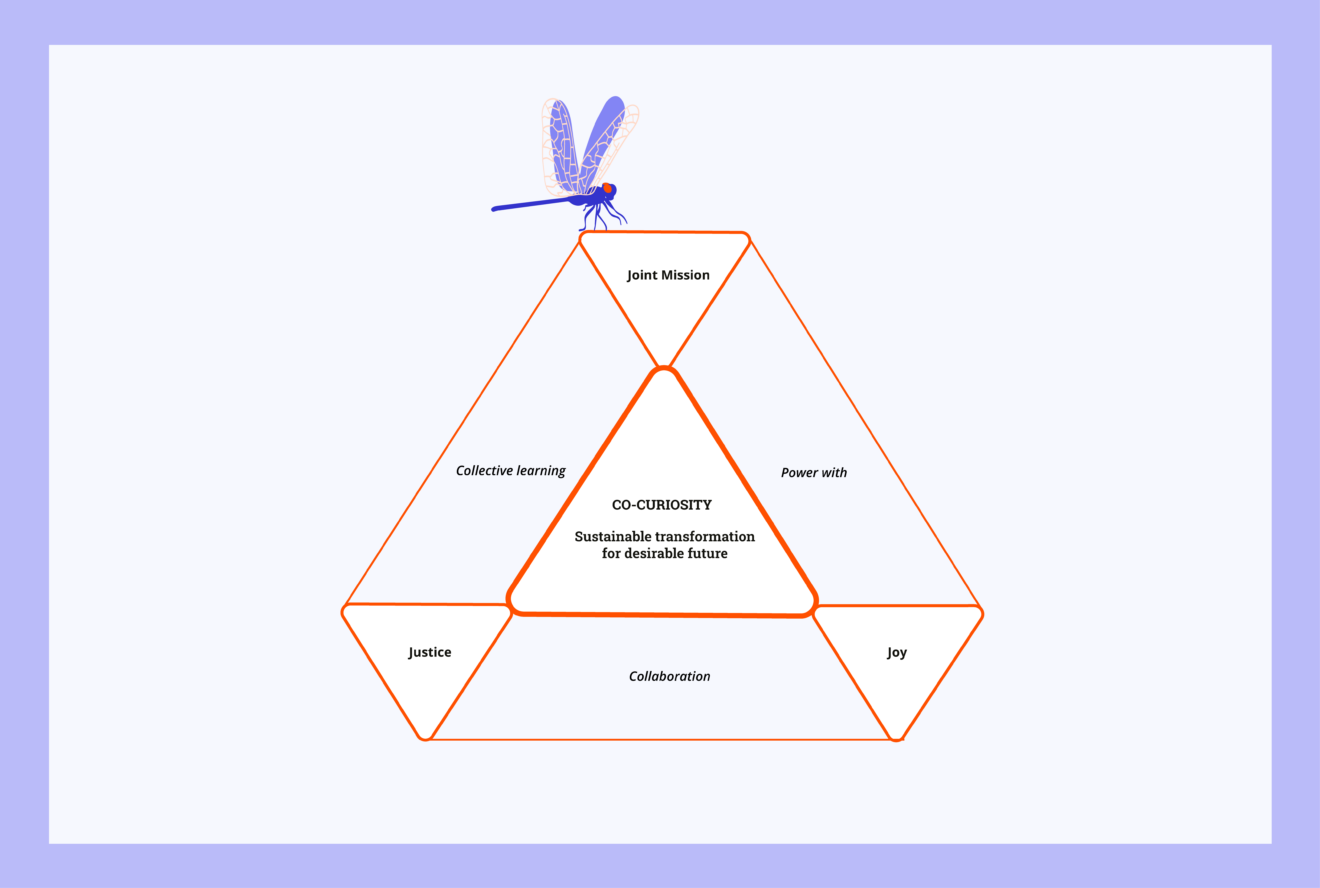
Co-curiosity may be understood as a shared object of interest. In collaborative RDI practice, however, its interest is understood broadly as a joint mission, encompassing a shared value of justice and commitment that arise from the joy of working together in RDI processes, thereby generating sustainable wellbeing (Ritvos et al. 2024).
The collaborative RDI partnership developed at Metropolia is both conceptual and practice-oriented, incorporating concrete tools and working templates. However, we seek to delve more deeply into the philosophy and practical enactment of reciprocal collaboration. To support this endeavor, we draw on research-based evidence from occupational therapy scholarship.
At the core of occupational therapy research lies human occupation, with collaboration as one of its central dimensions. Occupational therapy scholars have conducted pioneering and scalable research on the formation of collaborative action and collaborative relationships. The concept of co-agency, developed in Harra’s (2014) research, provides concrete substance to value-based, goal-oriented co-curiosity, collaboration that is goodwill-driven and generative of joy. This direction is further reinforced by the work of Restall & Egan (2021), who argue that that essential relational elements in collaboration are promotion of participation, equity and justice.
A shared interest alone is not sufficient to generate meaningful learning and participation; rather, it requires reciprocal co-agency, in which participants’ agency is constructed through interaction. Reciprocal co-agency, as conceptualized by Harra (2014), provides this shared knowledge interest with a relational and ethical foundation.
According to Harra (2014), reciprocal co-agency is not merely cooperation, but a relationally constructed, dynamic form of agency in which actors influence one another, recognize each other’s agency, and regulate their own actions in relation to others. What is essential is that agency is not an attribute of the individual but emerges through interaction. This perspective aligns well with collaborative research, development, innovation and learning in social communities.
Co-agency co-creates collaborative relationships
We will next present the three key elements of Harra’s (2014) concept, in which reciprocal co-agency promotes collaborative relationships. Finally, we will provide a summary and consider the implications for practice.
1. Relational Asymmetry
Harra’s (2014) concept of relational asymmetry makes visible the fact that co-curiosity can also be realized within differing roles, responsibilities, and forms of expertise. Co-curiosity is therefore not grounded in the sameness of actors, but in their shared interest and desire to understand phenomena that are meaningful to them.
By relational asymmetry, Harra (2014) refers to the fact that interactional relationships are inherently unequal. Asymmetry may relate, for example, to expertise, power or responsibility, roles (e.g. facilitator–participant, researcher–practitioner), or institutional position. From the perspective of reciprocal co-agency, the key point is that reciprocity does not require symmetry. An asymmetrical relationship can still be reciprocal if the agency of all parties is recognized and considered, and if actors actively regulate their interaction. For example, in participatory research: equality does not mean sameness.
2. Regulation of Interaction
According to Harra (2014), regulation of interaction refers to the conscious and context-sensitive fine-tuning of one’s actions in relation to others. It includes, among other things, listening and responding to others, limiting or sharing one’s use of power, making space for others’ agencies, and adapting rhythm, language, and modes of action. From a learning perspective, this is crucial: reciprocal co-agency does not emerge automatically but requires continuous and learnable regulation.
The realization of co-curiosity presupposes this form of interactional regulation, whereby actors adapt their actions so that the shared knowledge interest remains genuinely shared, and the agency of all parties is recognized. This process is supported by the virtues of reciprocity, which create the conditions for encounters between experiential and academic knowledge, for shared knowledge production, and for lifelong learning.
3. Virtues of Reciprocity
Regarding the virtues associated with reciprocal co-agency, Harra (2014) clearly introduces a normative and ethical dimension. The virtues of reciprocity include, for example, mutual respect, trust, fairness, openness, and responsibility. These virtues are not merely “good manners,” but conditions that enable agency. Without them, asymmetry easily turns into domination or token participation.
Implications in practice
The implications of the concept of reciprocal co-agency can be summarized as follows: it enables participation even in asymmetrical relationships, supports both formal and informal learning, strengthens the agency of individuals and communities, and creates space for shared knowledge construction and meaning making. In other words, reciprocal co-agency is both a prerequisite for and an outcome of a functional social learning environment.
In this sense, co-curiosity can be understood as the substantive engine of reciprocal co-agency: it orients collective action but takes concrete form only through interaction in which actors recognize one another as both producers of knowledge and learners.
The best solutions are created together
In conclusion, the combination of co-curiosity and reciprocal co-agency could serve as a framework for co-creation, as it allows us to conceptualise collaboration not merely as a method, but as a relational and ethical process of collective learning within complexity. By acknowledging relational asymmetries, consciously regulating interaction, and grounding collaboration in the virtues of reciprocity, RDI partnerships can move beyond instrumental cooperation toward genuinely shared knowledge construction, grounded in the understanding that the most sustainable and impactful solutions are created together.
In this way, the co-creation framework could emerge as an integrated approach to research, development, innovation, and learning (RDIL); one capable of addressing phenomenon-based solutions and fostering lifelong collective learning, with the overarching aim of the collaborative relationships to promote sustainable wellbeing.
References
Harra, T. 2014. Therapeutic Collaboration. Enabling Client Participation in Occupational Therapy. Acta electronica Universitatis Lapponiensis 156.
Huhtaniemi, M. & Vilkuna, A-M. 2025. TKI-toiminta rakentamassa kestävää ja elinvoimaista yhteiskuntaa. Metropolia Metrospektiivi Pro.
Restall, GJ. & Egan, MY. 2021. Collaborative Relationship-Focused Occupational Therapy: Evolving Lexicon and Practice. Canadian Journal of Occupational Therapy 88 (3): 220-230.
Ritvos, R., Sipari, S., Vilkuna, A-M., Vänskä, N. 2024. Co-curiosity – building justice, joy and joint mission into RDI partnerships. Metropolia University of Applied Sciences, TAITO-series 120.
Sipari, S., Vänskä, N. & Helenius S. 2024. Futureproof RDI Partnership. Metropolia University of Applied Sciences, TAITO-series 143.
Authors
-

Toini Palo
Principal Lecturer, Metropolia UASDr.Sc (Soc. Sciences) and Lic. in Philosophy Toini Palo is a researcher in Metropolia in Future Proof Health and Wellbeing innovation hub. She designs and conducts transdisciplinary RDI in the field of aging and health. Her interest is focused on health promotion, enabling meaningful life and co-design user-friendly solutions.
About the author -

Salla Sipari
Director of Research and Development Programme, Metropolia University of Applied SciencesSalla Sipari is the Director of the Research and Development Programme of Metropolia's Future Proof Health and Wellbeing Innovation Hub
About the author