Everyone knows what a post-it note is, but do you know the story behind it, that of the 3M’s scientist Spencer Silver who created them? In 1968, he was tasked with creating new adhesives, which should be stronger and tougher. Despite all his efforts, the scientist’s project was a failure. What he ended up with was a sticky substance that could barely hold two pieces of paper together.
But the scientist was persistent and talked about his findings throughout the organisation. Another 3M scientist heard about it and was able to connect it to a problem outside of work. He wanted to mark hymns that he would sing in an upcoming service. He used regular note squares but usually they had fallen out by Sunday. With this experience in mind, he describes a eureka moment after hearing from his fellow scientist’s experiments. Together, they started to test uses for the sticky notes, and by 1980 they were a hit. (The Making 2025.)
Collection van changes an industry
Another example is the charity retailer chief executive Maria Chenoweth who felt that it would be more appealing for people to donate their clothes if they could be picked up from their homes rather than having to take them somewhere (The Open University 2025a, 2025b).
Since her impulse was to always test things on a small scale before committing to anything bigger, she decided to ask a van driver to deliver flyers in a certain area of town to gauge interest in this service. After a while, the retailer’s whole pick-up service was built from there and it has been very successful ever since. This willingness to try small versions of one’s ideas is one of the first predictors of intrapreneurship.
What we can see from these two examples is that it was not extraordinary courage that set these individuals apart, but rather that they were willing to test something and willing to be wrong. What makes a test and failure more manageable is the scale at which it is done. It is not good for a business to invest heavily at the start but to take small incremental steps that make sense for the organisation.
Framework for advancement
These small steps can and should have a process, instead of doing them arbitrarily or haphazardly. That is where the 3-step framework of advancement comes in. Many people use these three steps interchangeably, but they are three different points of design and development that have a specific purpose. Making sure to understand and hit the limits and the goals of each of them will keep an individual or a group on track for advancing from an idea to something that is ready for implementation.
- Proof of concept
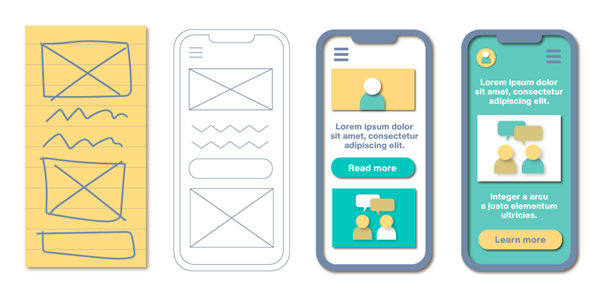
The first step in this process is a proof of concept. This is the smallest possible example of an idea to check whether it has any merit at all. The idea is not fully explored, just the core of it. The level of detail is very low, and the idea itself is often just a sketch on a napkin or a conversation with others.
- Prototype
The second step is a prototype. Once the idea has been researched and a better concept has been created, an individual or a group should create a rough but testable version people can interact with or react to. This can be made from lego, paper, or a mock digital interface. Check out this article I wrote earlier about prototyping. There are different levels of detail in prototypes with each becoming more defined and more time consuming. The level of detail can be increased every time you have done a round of testing with potential users and incorporated their feedback. Untested prototypes should keep their low level of detail until real feedback is gained.
- Pilot
The third step is a pilot i.e. running the developed concept in real time with real stakes when all the testing and feedback have been collected and acted on. To get to this point, there should have been many touchpoints with potential users. A pilot has an end date and is limited to a certain number of real users so that the data can be analysed as it comes in. Only after this will something be rolled out on a bigger scale. This piloting phase allows for the real users to give feedback and from this scheduled feedback process a real product can then be delivered to a wider market.
| Proof of concept | Prototype | Pilot | |
|---|---|---|---|
| Size | Small sample of the concept | One-off simulation of part of the concept | Continuous full test use |
| Complexity | Very low level of detail | Low level of detail | Medium to high level of detail |
| Functionality | Certain aspects – non-functional | Experimental – with shortcuts and such to minimise time spent | Functionally complete |
| Who uses it | For immediate validation on paper | For demonstration purposes | Limited to a small number of users |
| When this is done | Beginning of the development cycle | Early in the development cycle | First real deployment |
| Purpose | To see if there is any merit to the idea at all | To see if people will like the idea or service | To obtain real user feedback |
| Outcome | Begin to validate idea | Good for solving ambiguity | Used to prepare to scale up production |
Why this matters for people who do not see themselves as innovators
The fact that this is a learnable process makes it far more inclusive and attainable than it being framed as someone having certain ‘intrapreneurial traits’. Running through this process does not require someone to identify as a risk-taker or a natural leader. Being able to understand and follow this innovation process opens the door for people who are quieter and more methodical than innovators may appear.
In each of the steps in the framework for advancement, you should look for those people in the organisation that can help and support you. Maybe someone who has shown that they are interested in making improvements or someone who has connected with you to talk about your work. You do not need to be a ‘natural risk taker’ in order to make changes or even propose them. You just need to be willing to reach out to others and test some ideas.
Intrapreneurship is a form of internal innovation which means that you are taking initiative, identifying areas of needed improvement, and embody a willingness to take action. These things are not done despite our colleagues but together with them. Before including colleagues, it is good to define what you want to achieve. You can do this by asking yourself three questions.
A self-check before you start
The post-it note and the pick-up concept have one thing in common; they were both already existing in their organisations. So, before you begin planning anything, ask yourself these three questions:
What is my proof of concept? What is the smallest thing I can do to check this idea? Who can I have a conversation with about this that can give me an idea whether my idea is worth pursuing?
What is the cheapest prototype I could make? What is the simplest way to create something for people to interact with? Can it be done on paper or with a quick lego model or simple mock up?
Do I have enough evidence to try it for real? Have I asked enough people to say that this will work? Do I have enough evidence to make it real and build a pilot?
You do not need to be bold and take big risks, you just have to be willing to start small.
References
Holmlid, S., & Evenson, S. 2007. Prototyping and enacting services: Lessons learned from human-centered methods. In Proceedings from the 10th Quality in Services conference, QUIS, June 14-17, 2007. Accessed 15 September 2026.
Kumar, V. 2012. 101 design methods: A structured approach for driving innovation in your organization. Hoboken, N.J.: Wiley.
Post-it n.d. History Timeline: Post-it® Notes. Accessed 20 September 2026. https://www.post-it.com/3M/en_US/post-it/contact-us/about-us/
Spokes, P. 2017. Doing Unemployment Better: Using human-centred design to create an employment bridging service. Published 22 May 2017. https://urn.fi/URN:NBN:fi:amk-201705056483
Stickdorn, M. 2015. Service Design Process and Methods. Lecture. Laurea University of Applied Sciences, Finland.
The Making. 2025. How Post-it Notes Are Made – The $4 Billion Accidental Invention. Video. Published 23 September 2025. Accessed 12 October 2026. https://www.youtube.com/watch?v=Mbz46Rz677w
The Open University 2025a. Fostering an intrapreneurial culture. Knowledge Hub. Published 16 May 2025. Accessed 25 September 2026. https://business.open.ac.uk/knowledge-hub/latest-news-and-trends/fostering-an-intrapreneurial-culture
The Open University 2025b. Can you harness intrapreneurship? The intrapreneurship Series. Updated 7 July 2025 https://www.open.edu/openlearn/intrapreneurship-series
Author
-

Pamela Spokes
Specialist, Metropolia UASPamela Spokes is BA, MA, MBA and AmO Educator in Service Design and Entrepreneurship with the Turbiini Pre-Incubator Programme in English.
About the author