Metrospective Pop
Metrospective Pop publishes articles, podcasts and videos by Metropolia UAS staff and Master's students for the general public.
-
Pamela Spokes
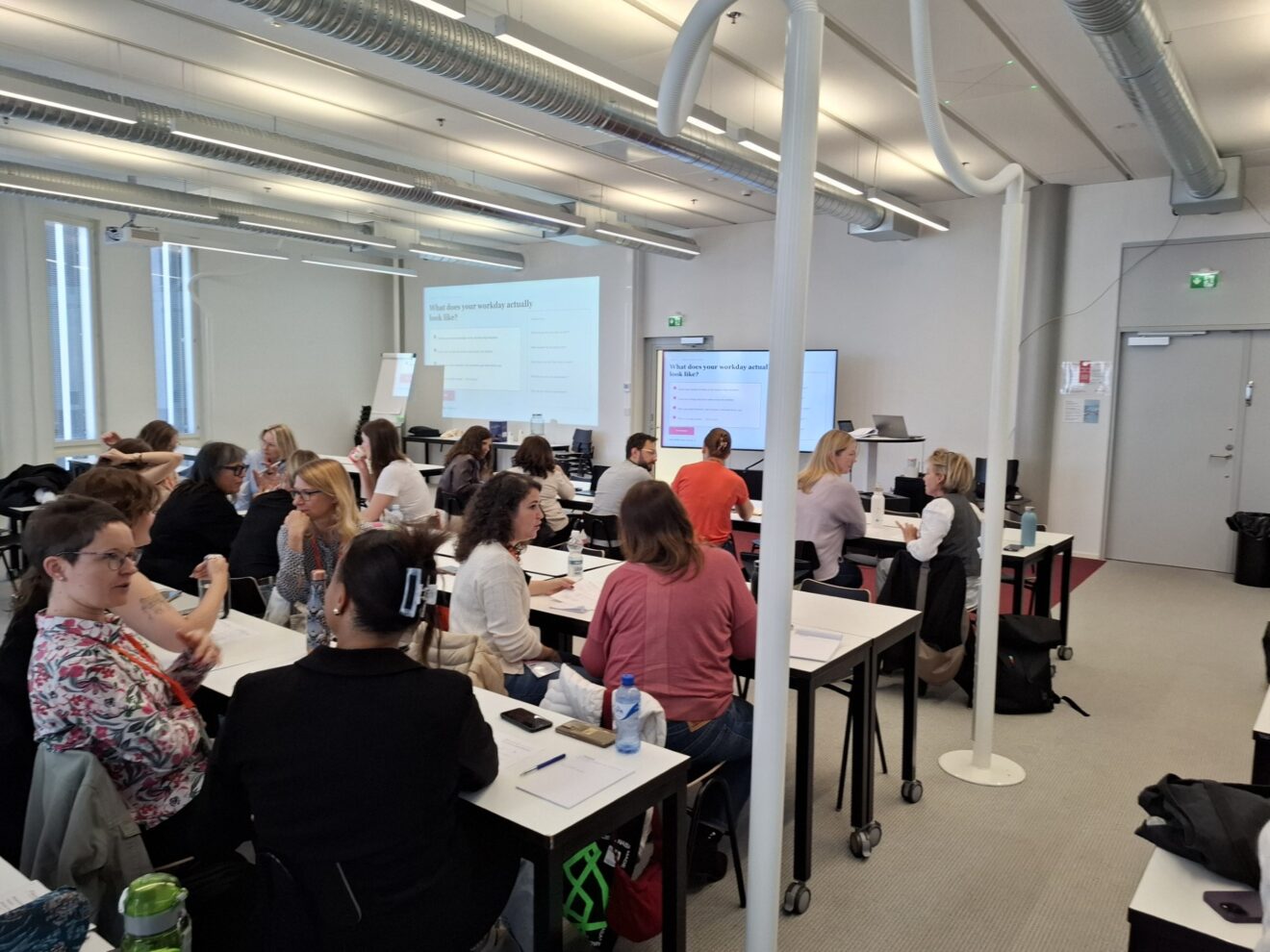
Designing better workdays
Workdays can easily be so busy that you end up eating lunch at your desk while still trying to type emails.
-

Heikki Laaninen, Jussi Salonen
Making XR easier to approach
Extended reality holds significant potential for game developers and companies, but its technologies and ecosystems can be difficult to navigate. Through Interreg BSG-Go! project, Metropolia University of Applied Science's Helsinki XR Center developed practical tools and hands-on experiences built around one core idea: lowering the threshold for anyone ready to take XR seriously.
-

Pamela Spokes
Why things can feel harder than they should
Friction is invisible to those who create it. Most services are designed for the organisation that built them — shaped by internal politics, legacy systems, and the blind spots of experts who have long forgotten what it feels like not to know. They can leave you feeling confused, defeated, or exhausted but you are not the problem.
-

Eunice Siame-Moono
Generative AI as a learning companion in bilingual nursing education
In functionally bilingual nursing education, learning is shaped not only by clinical content but by language, confidence, and access to practice. Drawing on my experience across student, support, and innovation roles, this article explores how AI can support more inclusive and practice-ready learning.
-

Toini Palo, Frank Guan
Episode 3: Learning in hybrid or remote simulation
In this episode of the Co-creating learning beyond borders podcast Toini Palo and Frank Guan explore innovative uses of virtual and augmented reality in education, focusing on simulation-based learning across international and cultural boundaries.
-

Heikki Laaninen
Stronger together: connecting the game development ecosystem in the Baltic Sea Region
The European game industry thrives on networks — but the hubs and clusters that support new developers have long worked in isolation. The BSG-Go! project set out to change that, and what it built may outlast the project itself.
-

Toini Palo, Agnes Xue, Peck Hoon Ong
Episode 2: Students, industry, and user-friendly age-tech
In this episode of the Co-creating learning beyond borders podcast Toini Palo, Agnes Xue and Peck Horn Ong explore the importance of user-friendly age-tech in supporting dignified and autonomous aging, and the wide-range of opportunities the field presents for students from diverse disciplines.
-
Toini Palo, Agnes Xue, Peck Hoon Ong
Episode 1: Getting mindset for the age-tech design
In the first episode of the Co-creating learning beyond borders podcast Toini Palo, Agnes Xue and Peck Horn Ong dive into the world of user-friendly age-tech design. What does it mean and require? How can we help students and entrepreneurs learn about it?
-

Pamela Spokes
From quick fixes to lasting change: teaching service design to future healthcare leaders
Long before a patient ever meets a healthcare professional, they have already navigated a web of services like appointment letter, directions, parking, and signage. When those services fail, the consequences can ripple through the system. Teaching healthcare professionals to ask better questions, not just find faster fixes, is where long-term change begins.
-

Ria Gynther
Making game industry competence visible
Game industry roles and skills often have multiple meanings depending on the context, which can make it difficult to see what career opportunities are available or to demonstrate what you can do. Gamebadges aims to change this by making industry-specific competences clear, understandable and demonstrable through a transparent verification system.
-

Ria Gynther
Finnish Games Week and the power of industry collaboration
In a period of structural change and reduced investment, the Finnish game industry faces increasing pressure to find new forms of collaboration. Finnish Games Week 2025 is a concrete example of how shared platforms and coordinated events can support developers, strengthen the ecosystem, and connect local talent with global audiences.
-

Pamela Spokes
The myth of the eureka moment – why innovation isn’t about sudden genius
The stereotypical depiction of a person engaged in creating something new usually plays out with a 'eureka' moment. The proverbial light bulb lighting up above their head. In reality, innovation is more likely to be the result of a hundred failures than a sudden moment of genius.