A patient arrives late for their appointment. Their name has been called but they are not there to answer. Staff get frustrated, and pressure builds to keep scheduled appointments on track, as some appointments may need to be squeezed or are missed altogether. Everyone wants to fix the problem. But what if they begin to fix the wrong problem?
The hidden services behind every appointment
Healthcare is full of services, and not all of these are treatment related. These services are usually an afterthought, but they can actually affect negatively the treatment protocols and queues that are experienced in hospitals and other healthcare related centres across the country. These services can be designed better.
This post shares what happens when service design is embedded into Master’s level healthcare courses at Metropolia UAS and what students learn about creating real change.
More than treatment: the full patient journey
A service, simply put, is “something that helps someone do something” (Downes 2022). That may seem vague, but it just means that services are all around us. The letter you get telling you when and where your specialist appointment is, the directions you are given on where to park, and how to pay, at their facility, the instructions you are sent to book your next appointment – these are all services.
There are many services that need to be designed to help you get from your house to your appointment in the least confusing and most efficient way possible. This isn’t just about providing more information, it’s about providing information that is understandable to the person receiving it, not just the person creating it. And the only way to make information more understandable to the reader is to ask potential users questions and to find out what makes sense to them; to understand them and their needs more deeply. These are all parts of the patient experience, even before they ever meet a healthcare professional.
By using interviews and other user research methods, service design can help help ensure that patients get to their appointments on time. The beginning of this article pictured a scenario where a patient didn’t arrive to their appointment on time, and described the knock-on effects this can have. But if we approach fixing this problem by simply thinking of the patient as “being late” and try to address that, we are just guessing at the reasons for their lateness. We then end up trying to fix a problem based only on our assumptions. What isn’t known in the above scenario is the possibility that they weren’t able to find a parking spot, or they could not find the right door to enter the hospital, or the bus was late, or any of many problems. So, what problem in this whole experience can – or should – be fixed?
Service design will help determine what needs to be fixed through proper user research and it will also help in ideating, building and testing solutions. This process, when taught to those who design and deliver services first hand, is very important to improving the real, lived experiences of patients in any healthcare setting.
Nobody seeks healthcare when they are perfectly well. Instead, people turn to healthcare professionals when a problem arises. Healthcare workers are good at solving problems and they usually need to act promptly and solve problems quickly, but sometimes quick fixes are not what the situation needs. Real long-term change needs deeper qualitative research and understanding the problem properly before solving it. Quick fixes can fade when shifts change or staff move on. A more methodical and long-lasting change needs to be employed. This is where service design and design thinking can make a significant difference. Training healthcare professionals to ask deeper questions when non-medical problems arise, like why patients are late or why they seem to get lost so frequently, can transform systems, not just the outcome for a single patient.
What we did at Metropolia UAS
Metropolia introduced service design to master’s level students studying Nursing Leadership and Development to help prepare them for future leadership roles (Spokes 2024). To ensure a strong combination of subject and process knowledge, we partnered a service design expert with a nursing expert to deliver the course. This approach equips future nursing leaders with the skills to improve patient experiences in a collaborative and purposeful way.
With a simple three-part model, we taught:
- Mindset: Human-centered design
Teaching the students that different stakeholders have a place in the process of designing these services so that when a problem arises, they can look at the problem in a more holistic way to try to solve it.
- Process: design thinking
Using the Stanford d.School 5-step design thinking process of Empathise, Define, Ideate, Prototype, and Test (Stanford d.School 2010), we were able to teach them a repeatable process to follow that makes the steps understandable in their busy profession.
- Application: service design tools & practice
Through the online course, we introduced different tools and techniques that are helpful for service design, for instance, how to conduct user interviews, create personas, and a journey map (Stickdorn et al. 2018). These showed the students how people, space and process are interconnected. These also made the students understand that they don’t need to be a designer to do this; they just need to be willing to be curious a little longer before jumping to conclusions or solutions.
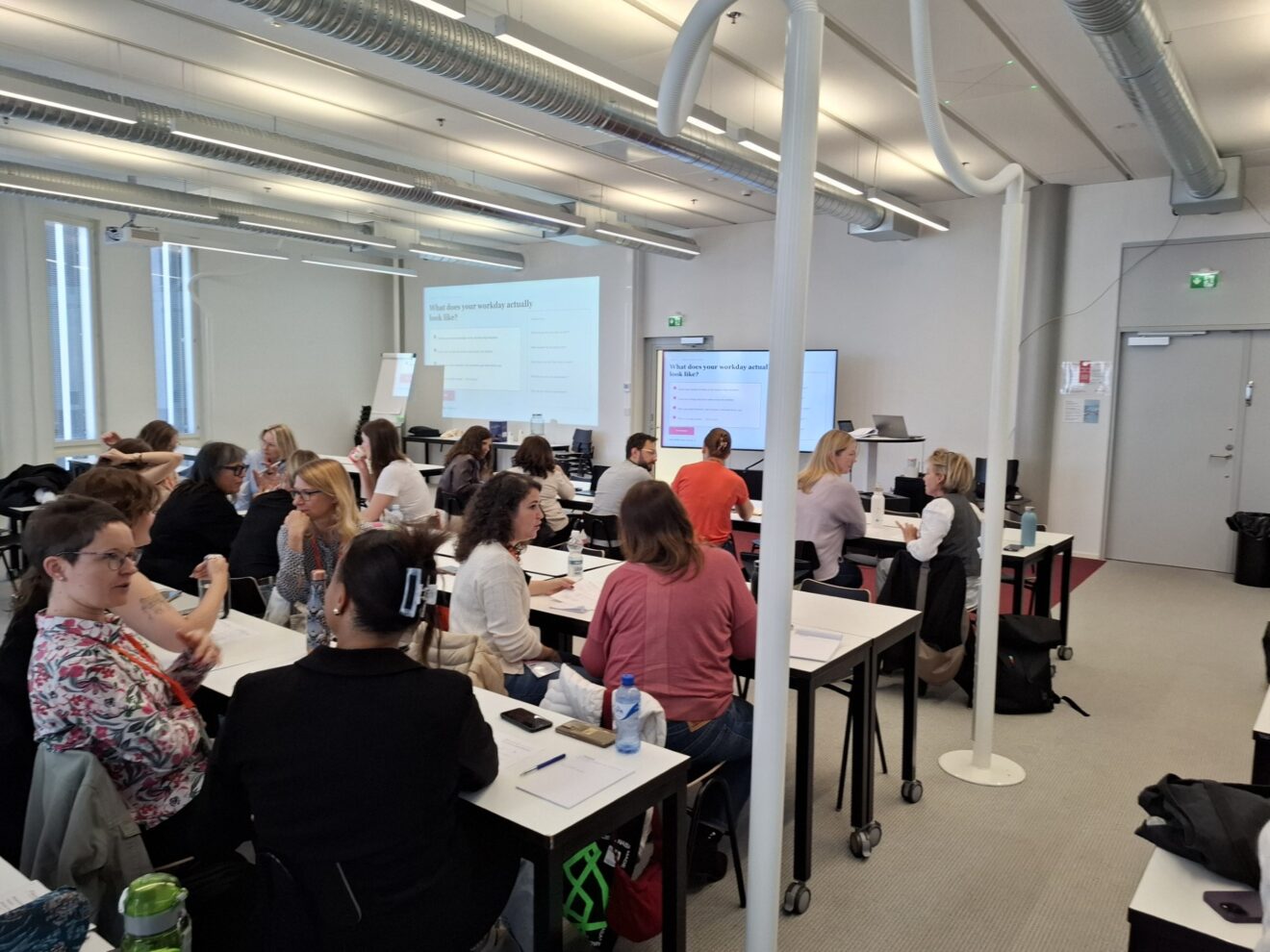
To put these new skills into practise, we had the students attend a one-day service jam on campus where they were given scenarios and support materials and asked to work on a solution for one whole day. This simulated scenario was able to provide a small glimpse into how to begin solving real problems in the healthcare sector. The students practiced every step in the service design process by doing it and not just reading about it. The students worked in teams of three and used a realistic outpatient clinic scenario that was created by the nursing expert in the teaching team. They were then guided through the process by the lecturers for an entire day.
What students took away
The outcomes were gathered in their personal reflections after the course ended. After their one-day jam, they were able to articulate why service design belonged in healthcare even when they had never heard of it before and they were able to identify the value of collaborating on fixes to create sustainable improvement instead of just trying to fix things instantly.
The service jam was essential for making the previous online lessons make sense and show why they are so useful and necessary. It made the process real. The combination of a subject specialist and a service design specialist was important to making sure that the learning stuck. This was vital because it allowed the subject specialist to answer healthcare-specific questions that came up – questions that I, as a service designer, would not have been able to answer on my own.
Why this shouldn’t stop at one course
This education should not be reserved for a specific class or a specific subject area. Healthcare in general and healthcare professions will always benefit from this kind of education. Making sure that services are run efficiently and are as user-friendly as possible will ensure the best outcomes. When the underlying problem is fixed, people will arrive on time and be clear on what they need to do and where they need to be.
Healthcare systems are complex and people inside them should not have to carry this burden alone. Service design helps develop more empathy, better systems, and more suitable and sustainable improvements while respecting patient dignity. The future of healthcare leadership won’t necessarily depend on having faster answers but on asking better questions and fostering collaboration.
References
Spokes, P. (2025). Embedding service design teaching to impact the future of nursing leadership and development – a case study. Perspectives: Policy and Practice in Higher Education, 29(2), 103–110.
Stanford d.School. 2010. An Introduction to Design Thinking PROCESS GUIDE. CA: Institute of Design at Stanford.
Stickdorn, M., Hormess, M. E., Lawrence, A., & Schneider, J. 2018. This Is Service Design Doing: Applying Service Design Thinking in the Real World. O’Reilly Media, Inc.
Author
-

Pamela Spokes
Specialist, Metropolia UASPamela Spokes BA, MA, MBA, AmO. Educator in Service Design and Entrepreneurship with the Turbiini Pre-Incubator Programme in English.
About the author