
The game industry is experiencing rapid structural change. Advances in artificial intelligence (AI), evolving production cultures and shifting player expectations are reshaping how games are developed and what competences are required from professionals entering the field. These developments pose clear challenges for game education, particularly in aligning curricula with industry realities while maintaining meaningful learning practices.
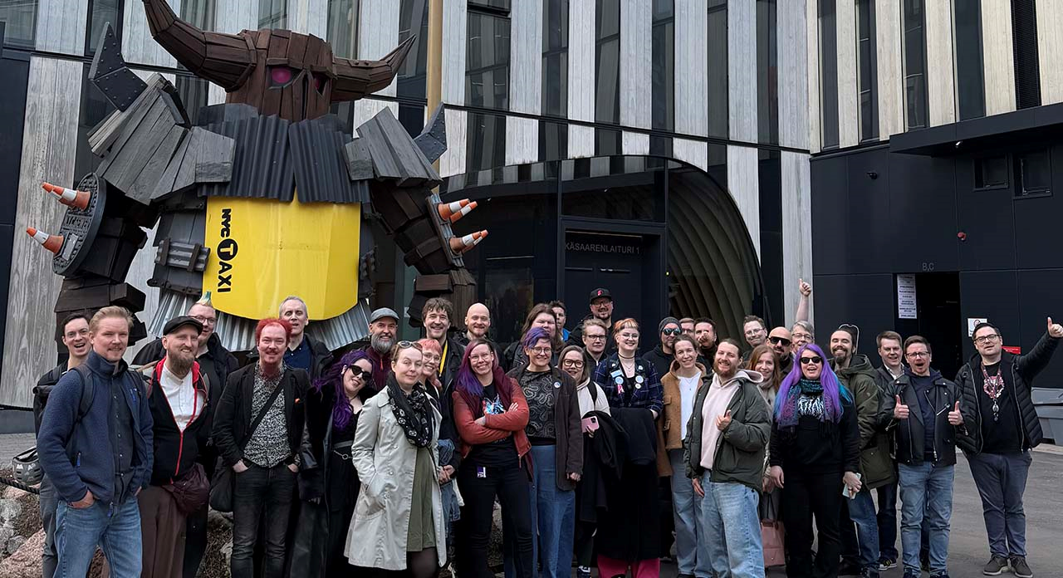
These questions were at the centre of the Game Educators’ Meeting (GEM) held in April 2026 in Helsinki. Hosted at Supercell, one of Finland’s most successful game companies, and organised by Metropolia University of Applied Sciences as part of the Gamebadges project, the event brought together educators, industry representatives and organisations to discuss current changes in game development and their implications for education. The programme combined industry perspectives on AI with concrete educational practices, most notably through a case example of integrating competence-based digital badges into higher education.
AI emerged as the most strongly requested topic in the pre-participation survey conducted among registered participants. The event attracted considerable interest among game education professionals, with 35 participants attending on site. Participants represented a broad national reach, including educators from major Finnish game development and education hubs such as the Helsinki Capital Region, Tampere, Oulu, Turku, Jyväskylä, Kajaani and Kotka (Neogames 2025, 8–9; 33–37).
Responding to game education needs thorough industry collaboration
Supercell has been particularly vocal about the opportunities and challenges of AI in game development, making it a natural partner for GEM 2026. Supercell continues to explore how AI can support creativity, iteration and production processes. In financial year 2025, the company reported revenue of €2.65 billion and EBITDA of €0.93 billion and paid €220 million in corporate taxes in Finland. (Paananen 2026b.)
Reflecting the event’s focus on AI, the keynote speech was delivered by Supercell’s AI Lead, Otto Söderlund, a technology entrepreneur with a background in machine learning and AI. He has co-founded the speech-recognition company Speechly which was acquired by Roblox in 2023. Söderlund’s keynote explored the potential of AI to accelerate iteration, experimentation and innovation in game development, drawing on experiences from both startup entrepreneurship and large-scale technology commercialisation. (Iglesias, Farr & Söderlund 2025; Aalto University 2024.)
AI drives the game industry transformation
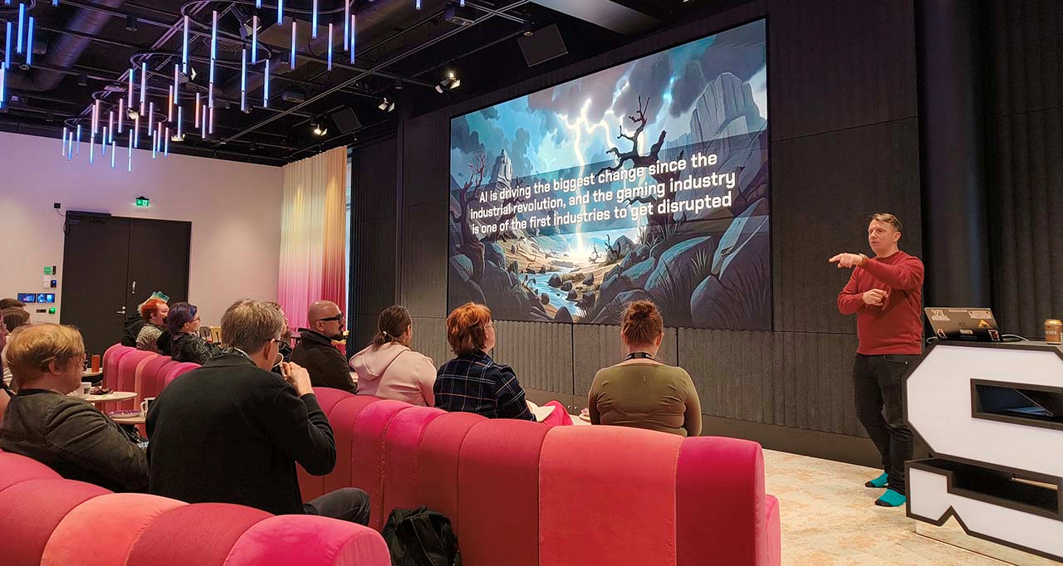
In his keynote presentation titled ‘How AI will change the Gaming Industry’, Söderlund described AI as a transformative force comparable in scale to the industrial revolution. The game industry is particularly exposed to this change due to its strong reliance on technology, data and digital production pipelines. (Söderlund 2026; Hemraj 2025, 5106–5109; Chapple 2025.)
Söderlund highlighted three interconnected shifts currently affecting the industry. The first concerns how players use their time, as AI enables increasingly personalised, adaptive and open-ended experiences. The second relates to how games are built. Along with human specialists, development teams are increasingly supported by AI agents that assist with coding, content creation and knowledge work. The third shift affects the wider industry structure, including production speed, platforms and global competition.
AI in practice: the Supercell approach
At Supercell, AI is seen as a superpower that accelerates innovation. Their AI use in game development is organised around three strategic areas. The first focuses on supporting people by automating repetitive tasks, accelerating creative iteration and enabling faster experimentation. The second aims to improve the operation of live games through tools such as player behaviour prediction, personalised user acquisition and AI-supported live operations. The third area explores future-oriented innovation, including AI-native games and new forms of interactive entertainment. (Chapple 2025, Paananen 2026a, Söderlund 2026; Iglesias, Farr & Söderlund 2025.)
The company also aims to keep pace with the rapidly evolving AI field by running new initiatives such as an all-expenses-covered, nine-week AI Innovation Lab, aimed at talent outside the company. This incubator supports founders working at the intersection of AI and games in rapid prototyping through mentoring, resources and opportunities to test concepts with users. The programme culminates in a demo at Supercell headquarters and is founder-friendly: Supercell takes no equity, participating teams retain full intellectual property rights, and the lab can open pathways into Supercell’s new games process, funding or recruitment. (Entreprenerd Media 2026; Supercell Oy 2026; Iglesias, Farr & Söderlund 2025).
Throughout the presentation, Söderlund emphasised that AI is not intended to replace creative professionals. Instead, at Supercell, it is positioned as a tool to amplify human creativity and support their current style of working in small, autonomous teams, ‘the cells’. This approach reflects the ideology of Söderlund as well as Supercell’s organisational culture, which values experimentation, risk-taking and rapid validation (Paananen 2026b; Söderlund 2024; Iglesias, Farr & Söderlund 2025).
This view is well in line with recent research, which suggests that generative AI is primarily used as an assistive component in game development workflows, while human expertise remains essential for refining, validating, and integrating outputs into production pipelines (Hemraj 2025; Ternar et al. 2026: 11–12).
Validation, prototyping and new competence expectations
Another recurring theme in the keynote was the growing importance of validation and hands-on experience. As AI accelerates production and lowers technical barriers, rapid prototyping, testing and iteration become increasingly important. Söderlund noted that employers are less interested in formal junior roles and more focused on evidence of having built and shipped games, tested them with players and learned from feedback. (Söderlund 2026; Paananen 2026b.)
This change has direct implications for game education. Students should be encouraged to start building games early in their studies and to continue doing so alongside theoretical learning. From an educational perspective, this places greater emphasis on practical competence, iterative processes and reflective learning, rather than linear progression from theory to practice. (Söderlund 2026; Iglesias, Farr & Söderlund 2025.)
Also studies across both professional and educational contexts indicate that the key value of generative AI lies in supporting early-stage ideation and prototyping, while human ability in evaluation, iteration, and validation remains central to meaningful game development work (Ternar et al. 2026: 12–13; Hemraj 2025).
Making competences visible: the Gamebadges approach
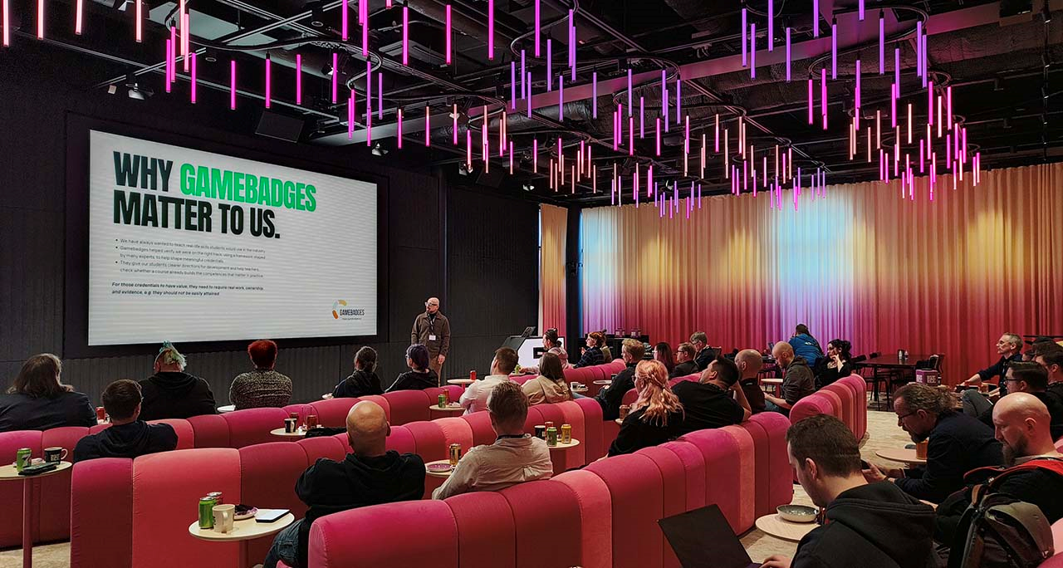
At GEM, educational responses to these challenges were explored through two presentations focusing on the Gamebadges framework: ‘GAMEBADGES: Skill Mapping and Micro-Credentials for the Game Industry’ by Saija Heinonen from Metropolia UAS, and ‘Gamebadges integration at Arcada University’, presented by Arash Sammander and Mirko Ahonen from Arcada UAS.
Gamebadges is a European competence-based open badge ecosystem developed for the game industry. Its aim is to recognise and validate professional competences through evidence-based assessment rather than formal learning alone (Heinonen 2026). The Gamebadges ecosystem is explained in detail in the Metrospective article Making game industry competence visible.
At Arcada UAS, Gamebadges is already integrated into the Game Design and Production course that emphasises project-based learning, teamwork, prototyping, playtesting and pitching (Sammander & Ahonen 2026). All these areas are covered within the Gamebadges ecosystem and illustrated in its recently published Competence Map.
Rather than restructuring the course around badges, the learning outcome goals linked to the badges were integrated into existing learning activities. This approach helped clarify which industry-relevant competences students were developing and made these competences more visible to both students and teachers. It has been observed that students often demonstrate a wider range of competences than they initially recognise themselves. (Sammander & Ahonen 2026.)
Such integration also had challenges. Course timelines and badge application processes did not always align smoothly, and producing individual evidence within team-based projects required additional effort. However, instead of seeing these tensions as shortcomings, they highlighted the distinction between participating in learning activities and demonstrating individual competence, which is also highly relevant in professional contexts. (Sammander & Ahonen 2026.)
From industry change to educational practice
The keynote speech on AI and the integration of Gamebadges into the Arcada course highlight a shared challenge for game education. As development practices evolve and new tools become embedded in everyday game development work, educational models must adapt accordingly. This adaptation concerns not only the tools used in teaching, but also how learning outcomes are defined, assessed, and made visible.
Competence-based approaches such as Gamebadges offer one way to respond to the challenge. By combining concrete evidence and expert evaluation, they support the kind of validation that the game industry increasingly expects. At the same time, they encourage students to take ownership of their own learning, become inspired and empowered, and to reflect on their skills in relation to professional practice.
Söderlund’s keynote further emphasised the importance of practical, end-to-end development experience for emerging professionals. According to him, the strongest junior applicants and recent graduates are already accustomed to working with the three principles of creating, validating, and shipping. From an educational perspective, this strongly suggests that students should be involved in the full development cycle already during their studies. This includes building playable games, validating their products’ viability through user testing, and ultimately publishing their work.
In Söderlund’s view, the future of the Finnish game industry depends on maintaining a strong ‘hacker spirit’, characterised by small teams that build, validate and ship ideas at a rapid pace. In a recently published profile article on Senior Creative Director and CEO Antti Ilvessuo, similar aspects are mentioned in his list of tips for beginner game developers (Mattila 2026). For game education, this reinforces the need to prioritise hands-on development, iterative learning, adopting the latest technology, and opportunities for students to experience the realities of contemporary game production.
Towards adaptive and competence-driven game education
The GEM meeting’s discussions underscored a fundamental shift in how competence is defined and demonstrated in the game industry. As AI reshapes development practices, uncertainty becomes a permanent condition rather than a temporary phase. In this context, game education can no longer focus on preparing students for fixed roles or stable toolsets.
Instead, the emphasis shifts towards transferable capabilities that remain relevant despite technological change. These include the ability to experiment, validate ideas through practice, reflect on outcomes, and take responsibility for one’s own learning. Full-cycle development competence, from creation to validation and release, emerges as a central educational objective.
Competence-based approaches such as Gamebadges support this direction by providing an agile tool and framework for the recognition of practical skills. When combined with hands-on and iterative learning models within formal education, they offer a concrete way for game education to align with contemporary industry practices while supporting students in navigating continuous change.
For educators, this means prioritising project-based learning structures, integrating validation practices into coursework, and embedding competence recognition mechanisms such as micro-credentials into curricula.
References
Aalto University. 2024. Otto Söderlund. Speaker bio for TedXAalto University. Accessed 10 June 2026.
Chapple, C. 2025. Supercell’s AI masterplan explained. Supercell AI lead Otto Söderlund explains the Clash of Clans developer’s strategy for AI and how it uses the tech in game development. News article 18.11.2025. Pocketgamer.biz. Accessed 10 June 2026.
Entreprenerd Media. 2026. Supercell AI Lab: Applications open for spring 2026 cohort, San Francisco, Helsinki and Tokyo. Accessed 21 April 2026.
Gynther, R. 2026. Making game industry competence visible. Published 31 March 2026. Metrospektiivi Pop.
Heinonen, S. 2026. GAMEBADGES: Skill Mapping and Micro-Credentials for the Game Industry. Presentation at the Game Educators’ Meeting (GEM), Helsinki, 14 April 2026.
Hemraj, S. 2025. AI and the future of creative development: redefining digital media production. AI Ethics 5, 5105–5119.
Iglesias, R., Farr, A. & Söderlund, O. 2025. Ep 17: How Supercell is supporting AI-native innovation with Otto Söderlund. Playing With Inference podcast. Published 20 August 2025. YouTube Music. Accessed 10 June 2026.
Mattila, M. 2026. Rämäpää Antti Ilvessuo kehittää hittipelejä. Published 19 April 2026. Yle. Accessed 19 May 2026.
Neogames 2025. The game industry of Finland report 2024. Accessed 21 April 2026.
Paananen, I. 2026a. How AI Is Changing Game Development Forever. ElevenLabs Summit. Published 20 March 2026. YouTube video. Accessed 21 May 2026.
Paananen, I. 2026b. The Best Games Haven’t Been Made Yet. Published 10 February 2026. Supercell blog. Accessed 21 May 2026.
Sammander, A. & Ahonen, M. 2026. Gamebadges, hidden competences, and why friction matters. Arcada, Culture and media blog.
Supercell Oy. 2026. AI Innovation Lab. Accessed 21 April 2026.
Söderlund, O. 2024. The Importance of Failure and Unlearning in Self-Development. TEDxAalto University. Published 25.11.2024. YouTube video. Accessed 10 June 2026.
Söderlund, O. 2026. How AI will change the Gaming Industry. Presentation at the Game Educators’ Meeting (GEM), Helsinki, 14 April 2026.
Ternar, D.-A., Denisova, A., Cunha, J. M., Kultima, A. & Guckelsberger, C. 2026. Generative AI in Game Development: A Qualitative Research Synthesis. Proceedings of the 2026 CHI Conference on Human Factors in Computing Systems (CHI ’26), Barcelona, Spain, 13–17 April 2026, 1–24.
Author
-

Ria Gynther
Project Coordinator, Metropolia UASAn a all-rounder in the game industry, engaged with the field and its topics since 2017.
About the author